
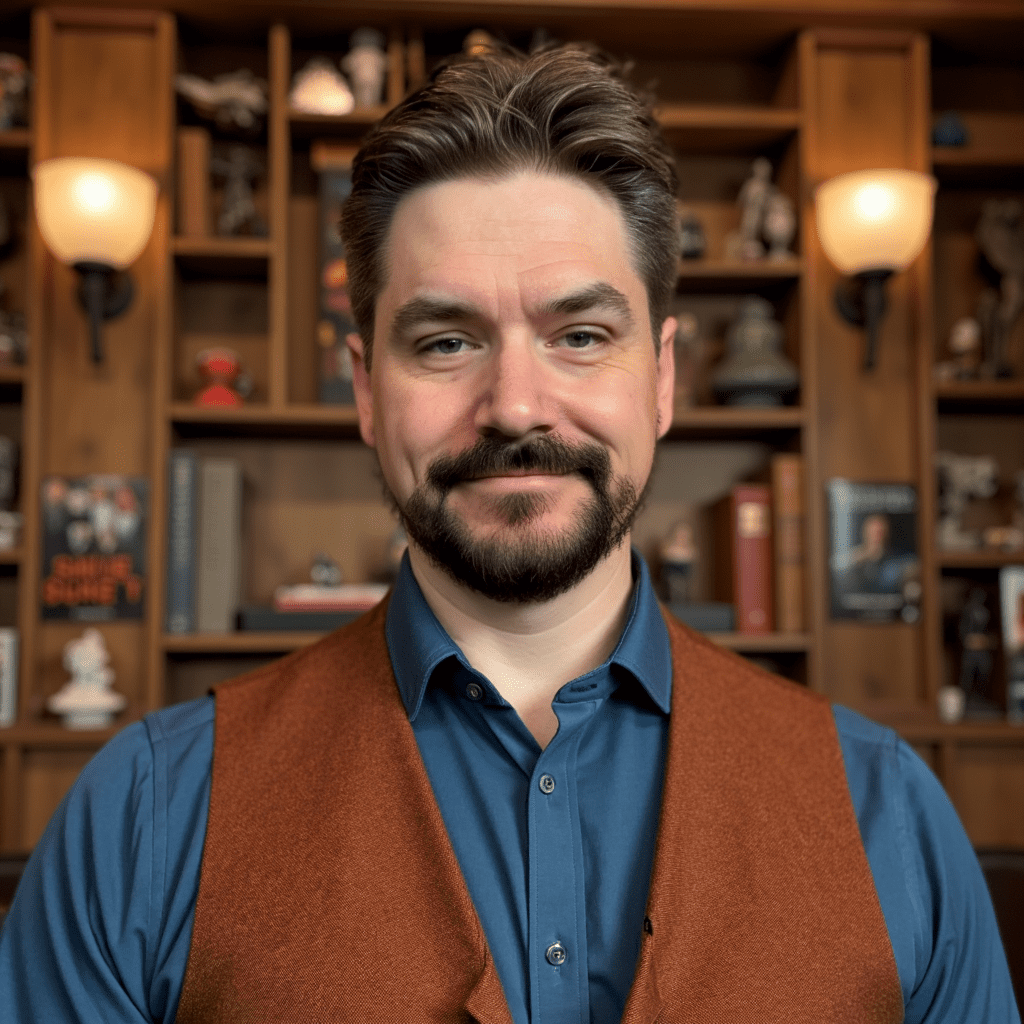
Paul Pape is a creative problem navigator, TEDx speaker, and author known as “Santa for Nerds.” Over the past 20 years, he has built a reputation as the specialty artist companies like Disney, Universal, and Nickelodeon call when they need something that doesn’t exist or their internal teams can’t build. Working from his Nebraska studio, Paul creates custom collectibles, props, and prototypes with tight deadlines and exacting standards.
Paul is the creator of Gamify Business and author of The Creative Player’s Handbook to Business, which translates intimidating business concepts into gaming language that creative minds actually understand. Through his books, workshops, and coaching, he helps entrepreneurs build sustainable businesses without sacrificing their creative souls, proving that the “starving artist” stereotype is outdated and unnecessary.
Paul first appeared on Follow Your Curiosity in September 2024, and I invited him to come back to tell us about his new Gamify Business program. Paul talks with me about how he recognized the need for a more creative metaphor for entrepreneurship; the danger of losing touch with your passion as your creative business grows; how the focus on what’s NOT possible, plus the constant need to ask permission—even as a adults—can get in our way, and a whole lot more. If you’ve ever been intimidated by the idea of starting a business, especially as a creative, this episode is for you.
Episode breakdown:
00:00 Introduction.
04:10 Using Dungeons and Dragons to explain creative business roles.
08:18 Leveling up business skills with gaming metaphors.
12:00 Business isn’t selling out; creatives deserve a livable wage.
16:05 Building the book through stories and personal experience.
20:13 Learning entrepreneurship by adapting methods to suit yourself.
24:10 Gatekeeping of business concepts and simplifying with new language.
28:47 Kids embrace entrepreneurship because they haven’t been told no.
32:27 Making a fool of yourself helps growth and confidence.
37:08 Confidence from passion attracts opportunities and like-minded people.
41:57 The tipping point: when passion becomes a draining job.
46:53 Failing is natural; our schooling overemphasizes perfection.
51:25 Coaching, permission, and feeling proud support creative entrepreneurship.
56:29 Rediscovering fun and permission helps creativity thrive.
Show Links: Paul Pape
Paul’s website
Subscribe!
You can subscribe to Follow Your Curiosity via the handy links at the top of the page for Apple Podcasts, Spotify, iHeart Radio, TuneIn, and YouTube. If you enjoyed the episode, don’t forget to tell your friends!

Transcript: Paul Pape
Please note: This is an unedited transcript, provided as a courtesy, and reflects the actual conversation as closely as possible. Please forgive any typographical or grammatical errors.
Nancy Norbeck [00:00:06]:
Welcome to Follow Your Curiosity. Ordinary people, extraordinary creativity. Here’s how to get unstuck. I’m your host creativity coach, Nancy Norbeck. Let’s go. Paul Pape is a creative problem navigator, TEDx speaker, and author known as Santa for nerds. Over the past twenty years, he has built a reputation as the specialty artist companies like Disney, Universal, and Nickelodeon call when they need something that doesn’t exist or their internal teams can’t build. Working from his Nebraska studio, Paul creates custom collectibles, props, and prototypes with tight deadlines and exacting standards. Paul is the creator of Gamify Business and author of the Creative Player’s Handbook to Business, which translates intimidating business concepts into gaming language that creative minds actually understand.
Nancy Norbeck [00:00:54]:
Understand. Through his books, workshops, and coaching, he helps entrepreneurs build sustainable businesses without sacrificing their creative souls, proving that the starving artist stereotype is outdated and unnecessary. Paul first appeared on Follow Your Curiosity in September 2024, and I invited him to come back to tell us about his new Gamify business program. Paul talks with me about how he recognized the need for a more creative metaphor for entrepreneurship, the danger of losing touch with your passion as your creative business grows, how the focus on what’s not possible, plus the constant need to ask permission, even as adults, can get in our way, and a whole lot more. If you’ve ever been intimidated by the idea of starting a business, especially as a creative, this episode is for you. I think you’ll get a lot out of this conversation with Paul Pape. Paul, welcome back to Follow Your Curiosity.
Paul Pape [00:01:47]:
Thank you very much for having me. I appreciate it.
Nancy Norbeck [00:01:49]:
So folks who have not heard the first interview with Paul, if you wanna know his whole history, it’s in a previous episode that I encourage you to go find. And, Paul, you when we talked last time, you were doing all the things that you do, creating amazing things out of nothing and finding a way to make a living at it. But now you are working on helping other folks figure out how to make a living at it, which is why I wanted to see what all this looks like and how it’s been going. So fill us in.
Paul Pape [00:02:22]:
Well, now you can actually see what it looks like. So basically, you’re right. I was I was spending the last twenty years making things for companies or people or whatever all around the world and being pretty successful at it. And then I decided I wanted to do a TED talk or TEDx talk. And so I got that under my belt last October. And in the process of doing that, I realized that there was a large percentage of people who were really interested in how I made the transition from wanting to be an artist to actually being successful at it. And digging into the TEDx talk, I learned that about ninety five percent of people who pursue a creative degree don’t end up doing it because they don’t know what to do. And so, in preparation for the the TEDx talk, I was, you know, basically, like, reaching out to people and I found a coaching client who was interested in my help.
Paul Pape [00:03:15]:
And, it was, three artists. They own a, basically, a dragon making company and they’ve been doing fairly well, but they are kind of lost. They don’t speak business language. They speak art language or creative language, which is nonlinear, I guess one would say. And, so I was sitting down with them one day and I asked them, I said, so what is everybody’s role in the business? And they told me that they do everything. And I’m like, well, you can’t run a business that way. You’ve gotta actually focus on something. So I said, how about this? Tomorrow, they’re big gamer nerds.
Paul Pape [00:03:44]:
I’m a big gamer nerd. And so I said, tomorrow, I’m gonna come back and we’re gonna play Dungeons and Dragons business edition. And what we’re gonna do is we’re instead of creating characters for each of you, your character will be the role in the business that you most, identify with. And so I came back the next day, we played for almost four and a half hours. It was wonderful. They had so many, like, light bulb moments in their job. They’re they’re like, oh, now I understand. And so I’m like, well, there’s a seed there.
Paul Pape [00:04:10]:
So then I went back and started really looking into it, and I found that majority of people, especially creative people, are gamers. And so I thought, well, why don’t instead of trying to overcomplicate business, why don’t we just distill it down to its basics and then approach it through the lens of gaming? So instead of leveling up your character, you’re leveling up your skills and your actual business. And so that’s what, this where gamify business actually came from was the idea that we can just gamify how we approach entrepreneurship or small business so that it’s not as daunting and it allows us to stay creative at the same time.
Nancy Norbeck [00:04:43]:
That is such a cool idea. I I will admit I have never played Dungeons and Dragons. I was I, you know, it was the eighties. It was one of those things that my parents bought into the, oh, D and D is evil, which obviously it’s not. So I knew other kids who had bags full of multi sided dice, and they were fascinating, but a complete mystery to me. But I never would have thought to approach business as a role playing game of any kind. And and I think I mean, my first thought because it’s you is did you go home and literally, like, remake everything in order to fit? Did you really?
Paul Pape [00:05:26]:
I did. I did. I because I’m I’m I gotta over complicate everything. But, yes, I went back and I rewrote because I’m I’m a nerd, so I know Dungeons and Dragons enough. I went out and bought my monster manual, updated it, player’s handbook and all that, and then I’m like, okay, what do we actually need here? Obviously, we can’t roll a die and say that I’m 12 strong. That’s just not the way it works in real life. And so instead of doing it from that approach, I thought, well, what if we do a sliding scale instead? So when we do actually fill out a character sheet. That is the very first thing that any client of mine does is we fill out a character sheet.
Paul Pape [00:05:56]:
And what the character sheet does is it allows the entrepreneur to step aside because as an entrepreneur, I’m flawless, everything I do is correct, and there’s no way of doing anything wrong. But the reality is is all of those things apply. So as an entrepreneur, we don’t like to look at ourselves as having flaws because then it slows down our progress. So what we do is we create a character sheet and we say it’s not you who has shortcomings, it’s your character. And then they’re like, oh, okay. That disassociation just a little bit allows them to really, like, look into themselves, do some retrospection, and then apply it to this fictional, not fictional character that is themselves. And so we go through there. But again, going back to, like, the strength and the wisdom, we don’t do that.
Paul Pape [00:06:34]:
But instead, we have a sliding scale of, like, are you more a traditional creative or are you more of a fantastical just, however you wanna approach it? And doing it as a sliding scale allows you to see kind of what your alignment is within the business world. And the reason that we do that is so that when we go out to look for party, which is why I look like I’m at a tavern because I’m the barkeep who has a tavern and that’s where you meet your party. I’m also the wise sage barkeep that sits behind there, just knows a little too much and that’s the guy you ask. But when you go to find your party, you wanna find people that align not on where you’re at, but on the opposite so they balance you out. In gaming, we have something called a party wipe, which is when you go out there and you fail miserably and the entire party dies. And that typically happens when you’re too lop sided. Nobody wants five warriors in a group. You need a warrior, a healer, long range damage, that kind of thing.
Paul Pape [00:07:25]:
And this is the same thing in business. We need a well rounded party so that you can be more successful.
Nancy Norbeck [00:07:34]:
Yeah. I think I think especially when you’re trying to do business on your own, that’s that’s a thought that really kind of fries your brain, I think. So how So
Paul Pape [00:07:48]:
I yeah. I mean, even myself, I’ve been I have been a solopreneur. We love that term. Throw that around these days. I’ve been a solopreneur for twenty years. And then I wrote the book, the first book, which is this one here, The Creative Player’s Handbook to Business. And I was working on another I was working on a fiction book, and I had a a, basically, a writing coach, and she told me, have you ever done your own book? And I’m like, what do you mean? She’s like, gone through the book and, like, see what the experience is like as player as opposed to the person who wrote it. And I’m like, why would I need to do that? I wrote the book.
Paul Pape [00:08:18]:
Well, she convinced me because I like to do my homework, and so I went through and it was eye opening to me. Like, I learned things about how I approach my business because I was being honest with myself, and I’m like, oh, these are where my not they’re not weaknesses. They’re shortcomings. They’re things that either you don’t wanna do or that you just really don’t have that knack for that you really need to find somebody to help you balance out on. So even I even I can work for my own stuff.
Nancy Norbeck [00:08:42]:
That is really cool though, And I totally understand the, well, why would I need to do that kind of reaction? Because I think that would probably be most people’s reactions. Like, I wrote the book. Why do I have to go through the book? But it’s so cool that that doing doing everything in the book still yielded insight for you.
Paul Pape [00:08:59]:
Absolutely. Yeah. It’s it’s I I think that’s the the biggest boon of this. And you mentioned earlier that you don’t play Dungeons and Dragons. You never played Dungeons and Dragons, but I assume you’ve played some kind of game where you’ve leveled up from one to 10, either at the Animal Crossing during the pandemic or Pokemon or even just playing Candy Crush or any of those games on there.
Nancy Norbeck [00:09:21]:
We don’t
Paul Pape [00:09:21]:
understand the necessity to do a certain amount of work before you can get to the next level and be better at it. And it’s the exact same thing in business. We just wanna get rid of all of the mumbo jumbo that really confuses nonlinear thinkers and just apply something that’s a little bit easier for them to get. Like, we all know that if I wanna be a stronger person, I’ve gotta level up my gear, I gotta level up my stats. It’s the same thing in business. We just like to approach it a different a different way.
Nancy Norbeck [00:09:45]:
Yeah. And that’s so true. I mean, especially for really creative folks, I think you say the word business and, like, I’m sure you’ve seen people just completely wilt at the sound of that word.
Paul Pape [00:09:59]:
Absolutely. Because we don’t I get two arguments from that one. It’s like, I’m not a business person. I’m just a creative or business is selling out. And it’s like Mhmm. Selling out if selling out means making an income that you can live off of, then let us all sell out. You know, we the the problem is is we’ve become a culture in which with Amazon or Walmart or whatever, we can pretty much attain anything for pennies on the dollar. Somebody is getting, pardon the phrase, screwed in that regard, but it’s usually a manufacturer that’s overseas, so they’re nonexistent to us.
Paul Pape [00:10:32]:
But as an creative, especially in The United States, we have to earn enough to be able to survive and that rate is higher. And so it’s we’re up against it when it comes to our customers because they feel that, well, you know, I can get that on Amazon for $10. Well, you’re not getting the exact same thing. And so we’ve basically forgotten what it’s like to actually earn a livable wage as creatives. And then when we do start making that wage, people look at us as though you’ve sold out to the man wherein the reality is is no, I’m making a living and doing the thing that I love to do. And so it’s kinda breaking down those barriers as well.
Nancy Norbeck [00:11:09]:
Well, and I’m I’m thinking, you know, you have you have two choices, and they’re not necessarily equal for everybody. But if you’re not if you’re not trying to make a living at the thing that you love, odds are really good. You’re trying to make a living doing something you don’t love and then trying to find the energy to do the thing you do love on your own time. So you know, which which one is actually selling out to the man? Like, if you have to actually go work for the man, I don’t think you’re necessarily a whole lot better off than if you’re trying to do this for yourself, where at least you get to do things on your own terms.
Paul Pape [00:11:53]:
Correct.
Nancy Norbeck [00:11:53]:
And, you know, I I think there is this weird cultural dichotomy about that stuff.
Paul Pape [00:12:00]:
Abs absolutely. I the amount of people that I have talked to that say, man, like, today is Monday. We’re recording this on a Monday. It’s like, well, five days till the weekend, four days till the weekend. I’m like, why are you living your life for only two days? Why aren’t you living your life for seven days? Like, this is literally your one shot here, you know, depending on what you believe, but it’s also like wouldn’t like, I would rather struggle every single day trying to do the thing I love, but knowing I’m putting seven days of my time on it reaping everything that I sow then to work five days for some amorphous unknown person to earn them money so that on the weekend, I can finally get to the thing that I want to do. It’s such a weird way to live your life.
Nancy Norbeck [00:12:42]:
I agree with you. I have always thought that it was a bizarre, you know, like the whole, thank God it’s Friday thing. It’s like exactly like what you said. What, what about the rest of the days of the week? What am I doing if I’m just dragging myself through this so that I get a couple hours here and there for myself? How does that make any sense? I mean, I think maybe it makes sense from a purely monetary standpoint, maybe, but I would tend to argue that you may not be doing as well financially if you’re just dragging yourself through those five days.
Paul Pape [00:13:18]:
Right.
Nancy Norbeck [00:13:18]:
And again, it’s gonna be different for everybody, you know. Sure. But but, yeah, it’s it’s a strange it’s a strange philosophy, I think.
Paul Pape [00:13:27]:
It is. And I’m I try to convince people that I mean, I’m working with a guy right now trying to convince him that he needs coaching. He doesn’t necessarily he’s not a 100% on board, but I was asking him, I said, look, what do you need to make as a creative to be able to quit your day job and pursue this full time, which is something that that person wants to do? And he said, well, I make right now $70,000. I’m like, that sounds awesome, you know. And and, unfortunately, as a brand new business owner, that’s unlikely. And so you’ll need a a subsidy there. You’ll need to either go there part time or work both jobs at the same time. But to give yourself that goal is okay, but just the idea that you can step away from your real job into the land of make believe here, through the land of entrepreneurship and still maintain that level is a fool’s errand.
Paul Pape [00:14:13]:
I mean, you’re really not it’s not possible unless you’ve already got it lined up, which most people don’t. They don’t know where they’re where they’re starting at. And they work really hard at, well, if I put all these pieces in place and then make the leap, then I’ll be secure because it’ll be an equal transition. It’s never an equal transition because you make that leap and then you don’t realize it’s actually 30 feet down that you gotta you gotta fall before you land and start running again. It’s never just the straight across bridge and it’s that I think one is the gate that keeps a lot of people from ever exploring that that realm. But also I think it’s something that we’ve misconstrued in our own minds is that, you know, if if I put the right pieces in place, I can be successful. And it’s true, but it’s never instantaneous. There’s you go viral once online, doesn’t mean that you’re gonna be viral every single post and it doesn’t mean you’re gonna be super successful at it that point forward.
Paul Pape [00:15:08]:
You got lucky. And hopefully, you can ride that luck over and over again in the transition, but to be realistic about it and then accept the wins is exactly that, windfalls. And then but then the losses don’t hit you so hard that first year when you’re struggling. I’ve got an entrepreneur friend. She’s like, this first year has been the roughest. I earned a fraction of what I earned. I’m like, yeah, that’s entrepreneurship. But this next year, to a much better.
Paul Pape [00:15:33]:
The year after that, much better again. And as long as you’ve got direction, then and that’s really what this helps to do is to clarify and give you direction. Then as long as you stay true to that path, you will excel and hopefully at an ex an accelerated rate.
Nancy Norbeck [00:15:48]:
Yeah. So how did you go about putting this program together? I mean, obviously, you got started with DND for business, but what did you know, how did how did it work to to kind of bookify it, and what did you learn?
Paul Pape [00:16:05]:
Well, I ironically, it was a it was a journey of self exploration. I was working with that book coach, and we were gonna originally write a memoir, but I’m not a real big fan of I’m like, nobody cares, you know. So I was like, what else can we do? But in doing that, I had written down a lot of the stories in this in I like, I look up to people like Adam Savage or or Alton Brown and and they basically had a different approach to the thing that they do that made their success. And so I got to thinking as I was putting these stories down, it’s like, what did I do in that regard? It doesn’t have to be overly personal, but it has to be like business related that has all these examples. And I wrote, I think like 70 stories of like things that have happened to me in the twenty years that are great learning experiences. And these are things that I’ve shared along the way. And I’m like, well, if these are all the learning experiences that I’ve had, how can I write a book around that so that people don’t fall into the same traps? And so I’m like, alright. Well, first off, we have to know what our business is.
Paul Pape [00:16:59]:
That’s the core of it and that’s really what the character sheet is. And then we start to build our world around it. I like to ask two questions. The first one being, what is it that you’re really passionate about? And the second one being, what is it that you do differently than everyone else? That’s your business right there. And then from there, we start to build the kingdom around it. And then I was like, well, when I first started, you know, I originally just wanted people to be able to have the thing that they wanted. So I’m Santa for nerds, you know, so I just want them to have that thing. And so there is my seed and and I could have been like, well, I can make anybody anything for anybody.
Paul Pape [00:17:27]:
I’ll go work for theaters. I’ll go work for film. And I can spread my self really thin, but instead I really like niched down on that. And that was all I advertised to. It’s all the blogs that I put out there. It was all about feeding this one niche. And then when I did that, it it kind of the path opened up before me. And so with this, it was the same thing in process.
Paul Pape [00:17:47]:
When you’re doing a Dungeons and Dragons campaign or tabletop role playing game, there’s one person who’s in charge and they kinda have an idea of where we’re trying to get to, but they leave the choice up to the players. And it’s the exact same thing that we’re doing with the system. We know that the end goal is to own and operate a very successful business within your niche. The how we get there is going to be filled with traps and monsters unless you’ve got a good guide. And so I was like, well, what if I could really help with that and be the guide who’s made all the errors? So these books are actually filled with all of those stories that I wrote. And so if I’m asking you to do something within the book to help bolster your character, to help really look for your ideal customer, These are things that I’ve myself has had to do and usually I screwed them up. And so I’m like, hey. Look at how I messed this one up.
Paul Pape [00:18:36]:
Don’t do this, but here’s why it’s important. And so along the way, you’ve got that wise old guy in the cave that says it’s dangerous outside, take this, to really help you through the process to kinda help alleviate some of the I don’t know what I’m doing type of feeling that a lot of entrepreneurs run into.
Nancy Norbeck [00:18:55]:
Yeah.
Paul Pape [00:18:57]:
That’s a long way of saying that.
Nancy Norbeck [00:18:58]:
There’s so much a lot, you know, I don’t know what I’m doing.
Paul Pape [00:19:04]:
But the thing the thing of it is though is is, Nancy, is that you really do. You do know what you’re doing, and it’s it’s that I hate imposter syndrome. It’s because every adult is an imposter. We we Absolutely. None of us know what we’re doing. Like, I’m a parent. They literally gave me a baby on the the second day it was born and said, good luck, have fun, and that was it. You know? Like, I don’t know what I’m doing.
Paul Pape [00:19:27]:
So you learn by watching others, by examining other people, by reading through their experiences. That’s why self help books are so huge. That’s why memoirs are so huge because we watch these people who are successful, who have done something, and then you’re like, I can try and emulate parts of this. But, obviously, we’re not that person, so we have to tailor it to ourselves to kind of fit. And, really, that’s what we we need to accept is that every journey is separate and it’s different and and but there are people along the way who are going through similar challenges that you can emulate and you could be like, oh, that’s how they got through that, and then just kind of fake your way through it, which we’re all doing, you know, and they kinda go through there. So to say that you don’t have the answers or that you’re lost is not true. We just need the somebody to say, yeah. You’re right.
Paul Pape [00:20:13]:
That that is the correct answer.
Nancy Norbeck [00:20:15]:
Yeah. Yeah. And and as you’re as you’re talking, there are two things that are coming to mind. The first is how much this reminds me of the choose your own adventure books from the eighties. Yes. You know, like, it’s all the same book, but it’s a different story depending on how you go through it. Correct. And the second is going to the Association of Writers and Writing Programs conference about, I don’t know, fifteen years ago or so.
Nancy Norbeck [00:20:43]:
There was a panel called stealing from the greats, and it was all, you know, okay, you don’t know how to write this? Who’s written it really well? Go and look at what they did and figure out how they made it work and then apply what you learned from that to the thing that you’re writing. And that sounds so much like what you’re describing.
Paul Pape [00:21:02]:
Yeah. I mean, there’s, you know, all roads lead to Rome is what they say or there’s a million ways to, you know, do anything and that’s in but but the reality is is we need a way we need someone to tell us the way that speaks best to us. Is this the best way for everyone to do business? No. Is it gonna fill that niche of somebody who really understands that language? Absolutely. And when I’m coaching people, I get a lot of people who are like, I’ve never played Dungeons and Dragons. I’m like, that’s okay. You don’t have to understand that, but you understand how gaming works. So if I said we need to level up, you’ll understand what that means.
Paul Pape [00:21:40]:
If I told you, you know, if I I ask a lot of people, I go, my favorite is, what is ROAS in business? And they’re like, I have no idea. It’s called return on ad spend. What does that mean? No idea. I said, well, if you are a character in a small town, you’re an adventurer, and you’re looking to go out adventure. Adventure is not falling in your doorstep, so you gotta go find it. So there is a bulletin board in Town Square that you can put up, I’m an adventure, what adventures can I go on? So you go out there with your nice little piece of paper and you’re about to tack it on the board and an old guy walks out and goes, hey, hey, hey, this isn’t free. You gotta pay me a gold piece a month. You’re like, okay.
Paul Pape [00:22:13]:
Well, then I put my thing up there, pay my guy my gold piece, and then over the course of that month, I see if anybody hires me. If no one hires me, well, then it was a waste of gold piece. Right? Well, that’s your return on ad spend. I spent a gold piece. I got nothing for it. But maybe I got 10 adventures out of it and I and I collected 30 piece instead. Well, my return on ad spend is 30 gold for the cost of one. Oh, well, that makes a lot more sense.
Paul Pape [00:22:36]:
Absolutely. And it’s really just the framework that that person can understand to really help them to, to get the point across. Like, your like your writing coach or, you know, the panel said, steal from the greats because they understand how to do it. As a writer, you’re like, well, that makes sense because I read a lot of books and I really like this person, this genre, this whatever, so they’re speaking the language that you understand, and that’s really all it’s about.
Nancy Norbeck [00:22:59]:
Yeah. It’s it’s fascinating, you know, like, there’s there’s such an entrepreneurial culture movement happening right now. I mean, it’s being taught in not just at universities, but, you know, high schools and even middle schools. Yep. I saw, I saw the most fabulous thing, Like, I can’t remember now what it was called, but it was some kind of like business day for kids. And it was all, you know, like I think elementary age kids. And then they all, they had their day to, you know, set up their booth and sell their stuff and see what happened. And I thought, that’s fantastic.
Nancy Norbeck [00:23:37]:
Also thought my 10 year old nephew would have eaten that up if it had been his school, you know? All of that is happening, but so little of it is really seeking to demystify it for people. Because like you say, somebody comes up and, and says an acronym like that at me. And I’m just kinda like, I’m sorry, what? You know, how how do we actually build this entrepreneurial culture if we’ve still got all of this jargon essentially gatekeeping it for people?
Paul Pape [00:24:10]:
Yeah. You need somebody to come in with a new glossary. One of my favorite things to do as a as, like, before I started this whole consulting thing or whatever is I love doing taxes, which is the most boring thing. But taxes and the independent contractor is, like, one of my favorite subjects to teach because I work with primarily a lot of artistic or creative people who don’t rake in a lot of money, but they’re also often freelance. And so they’re collecting a ton of w twos at the end of the year, and they’ve gotta pay a bunch of money on it. And I, through my gregarious nature, I guess, or my, you know, just me barreling through it, I learned that there are like, the tax laws are really complicated, and they’re complicated for a reason because you want a lawyer or a tax preparer to know how to work it for the rich. Only the rich people can apply to that. But I had a guy who was a CPA for the IRS in in California and he’s he basically taught me this entire system and now I apply it to poor people.
Paul Pape [00:25:09]:
And it’s not illegal, it’s just that we are un we didn’t know we’re it was gate it was kept from us, you know, it’s on high. And I’m like, well, it’s on high over here, but there’s a secret passage right over here and I promise you I can give you the exact same information. It’s just gonna seem a little shady because it’s not meant for you. I mean, it is for everyone, but they make it difficult on purpose and it’s the same thing of entrepreneurship. I liken it to like climbing Everest. It’s like, oh, I’ve got to master all this. I gotta get the cardio. I gotta get all the gear.
Paul Pape [00:25:38]:
I gotta get all this stuff in order to do it. But, when they were six years old, they had a lemonade stand. That’s entrepreneurship.
Nancy Norbeck [00:25:45]:
Yeah.
Paul Pape [00:25:47]:
You look at those kids. The one thing I love about those little conferences, and we’ve got one here in Omaha as well, is that the kids have never been told they can’t do it.
Nancy Norbeck [00:25:55]:
Yes.
Paul Pape [00:25:57]:
And so they’re like, yeah, I’m gonna sell rubber bands to people that I’ve turned into knots and they’re gonna be bracelets and I’m gonna sell a ton of them. And they don’t care because no one’s ever said that’s dumb. They don’t have their own prejudices or their own trappings that they’ve fallen into over time or all the things have been beaten into us, you know, to to tell them no. And so they’ve they’ve got the entrepreneurial spirit, but they just lack all the education and the funding to help get it across. And so what I’m trying to do is erase all of that and put it into a term that’s fun. And like, let’s do this exact same thing, but we’re gonna have fun doing it. We can do all these different things with it. And I think once people start viewing it as a game as opposed to this job, then they’re like, oh, yeah, I can do this, and it’s not that difficult and we erase that barrier that we’ve put in front of ourselves.
Nancy Norbeck [00:26:47]:
Yeah. And there’s there’s a quote that comes to mind that I’m gonna butcher because I don’t have it in front of me, but I think it’s TS Eliot said something like, you know, only those who aren’t afraid to go too far can find out how far they can go. And I I think that’s the same thing. You know, when you aren’t constantly being told, no, you can’t do that. No, you can’t do that. No, you can’t do that either. Then the world is much more open and available to you than if at every turn you’re told, nope. Nope.
Nancy Norbeck [00:27:14]:
Can’t do that. Can’t do that. And, you know, we do that to kids with the best of intentions, but maybe we’re a little too good at it.
Paul Pape [00:27:25]:
Especially nowadays with the with the kids that we have. I mean, I’m like, I’m a child of the seventies, seventies and eighties, and it was, you know, sun’s up, get out, street lights on, come back home. We had commercials that said it’s 10:00, do you know where your children are? Yep. Things like that. We don’t do that anymore. You know? It’s been ten minutes. Where’s your child? You know? Like, I got in trouble for having my kid walk to the park by himself. When I was a kid, I was driving five, six miles on my bike.
Paul Pape [00:27:49]:
But they’re like, no. You got a helicopter around your kids. And so we basically have cocooned them in this situation where we’re trying constantly to make sure that they don’t feel bad. And the best thing that they can do is mess up, fail, but then learn that failing is not a bad thing, failing is how we learn how to be better at things.
Nancy Norbeck [00:28:07]:
Yeah. I mean, you can fail well or you can fail badly. And if failure turns into, I’m going back into my room, dad, and I’m not ever coming back out, that’s not the good kind.
Paul Pape [00:28:20]:
No. I love to tell people you can either have a great time or get a great story. I mean, let me tell you, I got a lot of stories, but that’s good that’s but that’s a positive attitude to have towards it. And I think that when we when we go out there, if that’s how you approach life, there’s not miserable to have. I mean, don’t get me wrong, money’s tied and, you know, this whatever is going on in the world is going on in the world. But in my little insulated world here, I do believe that, like, going out to meet new people, I am an introvert. You wouldn’t know it, but I am an introverted person and I hate crowds. But I can go out there and know that I’m going to do my best and if I completely fall on my face, at least I’ve got a great story to tell people later on.
Paul Pape [00:29:00]:
And it’s just having that positive spin on things as opposed to, I’m gonna get overwhelmed. I’m gonna screw up. It’s gonna be horrible. No one will ever like me. It’s like, get rid of that. Get rid of the negativity and just try to approach it as though it’s an adventure. It’s a game. It’s supposed to be fun.
Nancy Norbeck [00:29:14]:
Yeah. And and I think, you know, I have often said that I will never stop telling the story of asking Paul McGahn to be on my podcast because, you know, so many people assume that you can’t go up to someone at an event like that and ask that kind of question, but I had the perfect opportunity. And so, you know, and, and they sometimes they’ll say, oh gosh, I I couldn’t have done that. And I was like, yes, you could have. Because as soon as you realize that you have two choices, go ask the question, risk hearing no, but know that if the answer is no, you’re walking away with nothing less than you had before. Or don’t ask the question and then wonder for the rest of your life what would have happened if you had. Which one would you rather do? And as soon as you realize that those are really your choices, it becomes much easier. I mean, which is not to say that, you know, my heart wasn’t pounding so loud.
Nancy Norbeck [00:30:12]:
I was sure the room could hear it, you know, because it was such an incredibly nervy thing to do. I say that now when I just go up and do that now without a second thought. But but, you know, as soon as you realize that there’s no way you wanna live with wondering for the rest of your life what would have happened, it becomes a whole lot easier.
Paul Pape [00:30:35]:
Yeah. Yeah. Another great thing to know, especially if your listeners are thinking about becoming their own business or starting a business or pursuing this even as a side hustle, is that the time that you spend thinking not about it, about not taking that leap, eventually someone will do it and they’ll be worse at it, but they’ll make more money at it. And so why don’t you just be the first to do it? Why don’t you do it right the first time and show us how it’s done? Like, the worst thing again, the worst that can happen is that you’ve you fall on your face, but you get a good story out of it. I love that you mentioned that it’s, you know, you went up there and you had the possibility of him saying yes or no. You had both of those choices. And I think that’s a problem that we we encounter as as humans is that we create a a narrative in our mind, we have the conversation already, then we go out there and we’ve already told ourselves what the answer is supposed to be. But it’s it’s not.
Paul Pape [00:31:27]:
Everything has opportunity. And so one of my superpowers is to be able to walk into a situation and be like it’s either, you know, to either go for it and understand that both outcomes are possible or multiple outcomes are possible, and I’m accepting of all of them, and I just keep moving forward. Once I discovered that, like, it was amazing, like, the the weight that comes off of you. It’s like, what’s the I will not die over this. You know? Right. It’s a conversation. You know? I get on here to do these podcast. You know? I’ve talked I’ve I’ve never we’ve met once before on a on a similar podcast, but I’m just gonna be open and honest with you.
Paul Pape [00:32:01]:
I’m just gonna have a conversation. And it I might sweat a little bit. I might be a little bit nervous, but I I think I’m really good at what I do. You seem genuinely interested in the things I have to say. What’s the worst that can happen? Yet I know people who just freeze
Nancy Norbeck [00:32:14]:
Mhmm.
Paul Pape [00:32:14]:
At this opportunity. And it’s like, what’s the worst what’s the like, if I failed miserably, if I vomited all over myself here, you’re just like, well, we’re not gonna use this episode. That’s the worst that can happen, and you’d get a great story out of it. But the reality is, like, okay. I made a fool out of myself. I’ve made a fool out of myself all my life. You know? It’s because that but that’s that’s the nature of life. I mean, that’s the adventure, the highs and lows.
Paul Pape [00:32:41]:
It can’t always be up here. You know, we’ve gotta have something to to learn from to balance it out.
Nancy Norbeck [00:32:47]:
Yeah. And, again, there were two things that are coming to mind here. The first of which is for anyone who’s listening who doesn’t already know, Paul McGahn said yes, and so have plenty of other people since then. And my experience is most people say yes. Now that doesn’t necessarily mean that we managed to make the interview happen, but going up and asking, most people say yes. And I’ve never had anyone be like, no. How stupid is that? What were you thinking? You know, that has never happened. I mean, of course, now that I say that first time for everything, but it hasn’t happened yet.
Nancy Norbeck [00:33:23]:
But the other thing that you just said about, you know, making a fool of yourself, I, I am so convinced that, that that is actually a superpower to be able to be willing to get up and make a fool of yourself in the name of learning how to do something or making somebody laugh or, or whatever it is, because you can’t, you can’t learn much in life just from books. You’ve got to get up and stumble around and find out what works. And the only way to do that is to be willing to be incredibly bad at it in the name of learning. I mean, that’s why I have a course called Make Bad Art, and that’s part of the premise is that we are deliberately going to do things badly. But also, you know, if I think of someone like Robin Williams, half of his job was making a fool of himself. And that’s part of why we loved him so much. You know? I really think that part of the way that most people, obviously, nobody likes everyone, but most of us reacted so strongly to him is that we recognize that part of ourselves from when we were a kid that was willing to go out and just do our thing and not care what anybody else thought and have a great time at it. And that part of us wants to come back.
Nancy Norbeck [00:34:50]:
You know, it wants to be let back out to play, even though our culture has spent years of our lives saying, no, you can’t do that. No, you must, you must stand up straight and stiff upper lip and, you know, make sure that your tie is straight and and all of that kind of stuff, which is one way to be, but it’s not a lot of fun.
Paul Pape [00:35:11]:
No. No. But there are people who want that, and that’s fine for those people. Yeah. But I would say the vast majority of people don’t. I agree. They want something else. I mean, my my father-in-law, he spent his entire year.
Paul Pape [00:35:23]:
He’s a family man. He did his job. He raised his kids. He earned his living. He did something that he found fun in, but it wasn’t necessarily his passion project. But at night, he would come home and he would tinker on cars or he would do motorbikes and these kind of things. And now that he’s retired, what does he do for fun? He works on cars. He works on motorbikes.
Paul Pape [00:35:41]:
He does all these things. And I’m like, why did you wait until your body’s nearly failing to jump onto that bandwagon? Well, you know, I had responsibilities. I’m like, you could have had responsibilities and done the thing. You would have just had a rough few years because your passion’s there. And let me tell you, there is nothing more alluring to a customer than the confidence that you carry with you that you know what the hell you’re talking about. When, you know, if it and as an example of this, if you’ve ever walked down the street and you’ve seen somebody dressed in the craziest outfit and you’re like, I would like, the the cojones on that person for wearing that outfit, for looking that way, and that person didn’t think twice. They didn’t they didn’t get dressed and go, I don’t think I should look like that. They’re just like, this is who I am, that that confidence, and they walk with that air and people will turn and look.
Paul Pape [00:36:27]:
It’s the exact same thing. If you follow your dreams, your passion, you create an aura, and you don’t need to believe in any of that, but that confidence, we can smell it. It’s either a pheromone, I don’t know what it is, but that confidence of knowing that you that that you believe in yourself is alluring to others. And if you’ve ever, you know, some of the best speakers out there, it’s because whether they’re speaking for good or for evil, they have that confidence. Every single one of them that they are are right and they just exude that and people will follow because it’s easier to do that than it is to try and make your own way.
Nancy Norbeck [00:37:06]:
Yeah. Just have
Paul Pape [00:37:07]:
to choose which one you want.
Nancy Norbeck [00:37:08]:
Yeah. For sure. For sure. And I think that’s where a lot of people get hung up too, because they’ve not only been told that going the usual way is the only way, but that doing something different looks so hard because they have no idea how, and they think that they would be the only one who’s doing it, which is where I think, you know, community is really powerful. If you can find other people who are doing the same thing as you, you eliminate that voice in the back of your head that says there’s something wrong with me. I shouldn’t be doing this. I’m the only one who is swimming upstream. What’s wrong with me? You know, when you know, you’re not the only one, a good chunk of your confidence can come just from that fact.
Paul Pape [00:37:51]:
Absolutely. Absolutely. I like to say I mow my own path, but the grass is about seven feet tall. And I could be next to the success, I could be a foot away from the next big thing or a mile away. I don’t know, but I’m just gonna keep going. And I can hear the other mowers, they’re around. So other people are doing this. Now, there’s a four lane highway that the majority of the people are on, but they’re stuck in traffic and they’re hating life.
Paul Pape [00:38:18]:
I’m working. I’m getting where I wanna be, but I don’t know. There’s a lot of I don’t know in that. But every once in a while, my path will cross with somebody else’s and I’m like, hey, how have you been mowing? Like, well, I’ve been mowing for five more years. I’m like, great. What can I learn from you? And then we exchange some stories and we go along our merry way, and that’s really what it is. And but I’m I’ve got the confidence and the gas to keep pushing that mower, and that’s the that’s the point. And that’s really what we should strive for, And it’s not just for entrepreneurship and business.
Paul Pape [00:38:46]:
We should all be striving for this as humans just in general because to like we had talked about in in at the beginning is to live our lives only for two days a week seems like such a waste if we just have the confidence in ourselves and the thing that we love, you know, and that you’re passionate about, then, you know, you you will exude in situations that confidence and and it helps build you up as a human as well.
Nancy Norbeck [00:39:11]:
Yeah. Yeah. Absolutely. And I think that that kind of building up of the confidence is such a key part of trying to navigate the rest of it. If you’re if you’re telling yourself that you’re on the wrong path and there’s something wrong with you and that this is a mistake the whole time, you’re not going to get where you want to go. I mean, that’s just pretty basic kind of mental arithmetic for want of a better metaphor. You know, your, your numbers are not going to add up if that’s what you really believe. I know that there’s, there’s a tipping point between the happy creative entrepreneur and the very unhappy creative entrepreneur.
Nancy Norbeck [00:39:57]:
You know, you take that thing that you love and you try to turn it into a business. And the business side is just draining all the joy out of the thing you love. And I’m wondering what you’ve seen about, like, where that tipping point is, if there’s something in common with people that that happens to or tips for how to avoid being that person.
Paul Pape [00:40:19]:
Yeah. It it happens to every single person. Every there’s no exception. None. The difference is once your passion becomes a job, that’s the tipping point. So what happens is typically we start and we’re making onesies, twosies, or we’re making things that we’re really passionate about and we’re selling them or showing them the friends and family or we’re helping people that know us, friend circles. It’s when we start to explore out into the the we expand our bubbles is what I like to call it and it’s just the to random people. In business, we like to use the term cold calling or or cold outreach.
Paul Pape [00:40:52]:
It’s the worst where you’re like, hey. I I want someone to hire me. And it’s once you hit that that that point, that’s where the tipping can happen, and it’s because we have that uncertainty. Because now we don’t have the support of the people that we know and love saying this is really good. You’re really good at this. Now I’m gonna put it into the hands of strangers, and now is the first time that I might be told no or that you’re wrong. It’s horrible. And then add on to that the process in which we have to do the outreach.
Paul Pape [00:41:24]:
Well, now we’re getting into business. Well, you know what? I make things or I paint or I do, you know, whatever it is that you do. Even if you’re a CPA, it’s like I crunch numbers for business. I’m not out there looking for customers. That’s a completely different job and so we have to learn a skill and honestly, most creatives that I know are not good at it. That’s a that’s a hard step for them to take. And so what we have to do is we have to teach them methods in which that’s where the game comes in. It’s like, oh, if you if you do this 50 times today, then you’re gonna level this up.
Paul Pape [00:41:57]:
And we give metrics on there as well. So it’s like, oh, if I put out, you know, 50 cold DMs on LinkedIn of all places to see if I can connect with people who are like minded so that possibly I can get some work out there, then I slowly start like, that’s that’s scary. I don’t wanna do that because I’m nervous that they’re gonna turn me down or I’m I’m just gonna be speaking to the void. But what I do is I look for that connection number to go up. Oh, somebody they may not even ever reply to me, but they might be like, oh, that guy’s interesting. I’ll follow him. Okay. So then I noticed that number goes up, and that’s not a generic number.
Paul Pape [00:42:31]:
It’s not bought people. This is someone I’ve genuinely reached out to who’s like, interesting. They may not hire me immediately, but it’s out there. And and so now I’m seeing a metric. Well, my gold just went up or my XP or however you wanna put it. That game you’re starting to gamify it, and then it becomes the challenge of the game. It’s like, oh, okay. Well, can I put out 50 today and get 50 or can, you know, can I balance those numbers out? Can I get a higher score? And the person you’re competing against is you.
Paul Pape [00:42:57]:
So you don’t have to worry about anyone else in this and then eventually that tipping point, that scariness becomes part of the thrill of the hunt. That’s the part of the game that we’re like, okay, now I’ve and then once you get that first customer, that’s like getting your first monster encounter. And it’s like, oh, now I get to I get to use all those skill sets that I’ve been building to see if I can conquer this challenge. And it’s sometimes the challenge is selling an object. Sometimes the challenge is coaching a person or however you wanna do it, but that becomes the challenge. And then if you win or lose, okay, well, can’t win them all and so but that mindset’s still there. It’s a game, so I’m gonna keep applying it. And then, well, maybe this approach didn’t work, so those weapons weren’t the right weapons for the job.
Paul Pape [00:43:39]:
So now I’m gonna try some different ones on a similar foe, you know, customer or whatever, and then you’re constantly adapting, but now it’s fun. It’s it’s like it’s a challenge. You get to think about it. Obviously, if you’re not into games, we could use a ton of different metaphors. I had a friend of mine who’s all into race cars, and it’s the exact same thing. You’re gonna try and pass somebody because you wanna be in the lead. Well, that car swerved at the last second. You weren’t able to get around it, so you didn’t get that one.
Paul Pape [00:44:05]:
But the next time you approach it from the inside as opposed to the outside, well, then you were able to pass. Same metaphor. It’s just however it clicks in your brain so that you understand the process. So I think that’s how we avoid the tipping point. And the other thing is is honestly, like, once the fun becomes a job, then we you need to take a step back because you’ve lost the thread. You should when we talk about, like, distilling down and finding your seed that becomes your business, it your passion should be in there. The passion that that answer should never be fame, money, notoriety, whatever. You wanna write a book? Great.
Paul Pape [00:44:42]:
Not because you wanna sell a thousand books or a million books. You wanna write a book because you wanna write a book. Yeah. You know, and it’s the same thing. And your priorities have to be straight. I talked to a lot of high schoolers and and middle schoolers and about this type of situation and they all wanna be influencers or YouTube stars or gamers. And I’m like, cool. There’s millions of you out there.
Paul Pape [00:45:02]:
What are you doing that’s different? You know, if you’re gonna be an influencer, let’s break that word down. You’re influencing someone on something, you know, not just how to play a game, but you you are so passionate about it that people want to seek out your knowledge to be influenced by how you approached it. So let’s all do that in the thing that in the thing that we’re doing. Obviously, it’s not gonna affect everyone equally, but that once we keep that seed and we stay focused on that, then the business parts of it, they’re hard to get through, but the challenge is there because we’re still devoted to that that thing that we’re really passionate about, and we don’t let the other stuff kinda drag us down.
Nancy Norbeck [00:45:38]:
Yeah. That that fits. It’s it’s when the passion for the thing dies that you’re in deep trouble.
Paul Pape [00:45:47]:
Absolutely. That’s why it’s the first question. Like, what are you passionate about, and what makes you different from everyone else? Because if you’re not passionate about it, you know, I I my my oldest son is like, dad, can you help out a friend of mine? They need to do a presentation and need to ask you some questions. I’m like, sure. Of course. I’m gonna help my kid. So this person sets us up. It was Cutco.
Paul Pape [00:46:08]:
I don’t know if you’re familiar with Cutco. Mhmm. Knife sales. And I’m like, how did I get roped into this? But the reality is is that person is trying to try something new, And I’m like, I’m gonna give them the benefit of the doubt. I will sit through it. I’ll be upfront and say, you know, we’re not buying anything, but I’ll listen and I’ll help you to experience what it’s like talking to someone else. But, you know, they’re they’re trying. They’re they’re flexing a muscle of that entrepreneurial ship with an umbrella behind them that says you can, you know, we’re we’ll give you all the scripts.
Paul Pape [00:46:37]:
We’ll give you all of this stuff. And it’s once they do it enough, if people are nice enough to sit through it, then they start to get a natural rhythm to it, and they become better at it. And I think that that’s it’s it’s just one of those things that we have to all go through to be able to move ourselves forward.
Nancy Norbeck [00:46:53]:
Yeah. Yeah. It’s a learning process like any other. Learning and failing and learning through failing, as we keep saying.
Paul Pape [00:47:02]:
Now that’s the thing that I think a lot of people just really get hung up on is is the the failing. I I and I think a lot of it comes from our schooling, you know, especially as in the eighties and I or even now, it’s all test scores. You know, my my son’s schools will send back paperwork. It says, make sure that they eat well today because we’re doing our our state testing today. And I’m like, why is that the like, I should feed my child every day, shouldn’t I? They should be well. Not just on test days, but we we have put so much importance on that metric as being the success metric. But that is it it it it’s the median. You know? There’s gonna be high and low on that, but it doesn’t mean anybody who’s super achieving is gonna be any better than the person who’s low achieving just because it’s just a test or or whatever.
Paul Pape [00:47:48]:
It’s we built our that into our education system. And so the idea of failing, it’s like, oh, I failed the test or I failed I’m literally in a coaching session right now and I’m like, well, I don’t wanna fail. I’m a 50 year old man and I’m concerned about getting an f in a thing that I’m paying to be in. I’m like, you can’t fail something, you’re giving them money. I’m like, but that mentality is there. It’s been there since I was I was a little kid, and it doesn’t go away. And so you kinda have to break through that, or just know that it’s there. It’s gonna be that little creature that sits on your shoulder, and you’ve gotta feed it when it needs to be fed, but ignore it the rest of the time.
Nancy Norbeck [00:48:25]:
Yeah. And I think that’s so true. I mean, millions of us were terrified to bring report cards home every quarter because, you know, whatever the the threshold was in your family that you were afraid you didn’t meet and you were going to catch hell for it when you got home. And it, it happens, you know, in, in corporate situations too, all the time. You know, why isn’t this thing perfect? Well, cause I’m a human being and we’re not made to be perfect all the time. So sorry. Let’s fix it. Did anyone die? No? Okay.
Nancy Norbeck [00:48:57]:
And yet an awful lot of time, people react like somebody died. Yep.
Paul Pape [00:49:03]:
And that Have you ever met a perfect person? Nope. Yet to be a perfect person. So the fact that we tell our kids they have to bring bring home straight a’s, that means you have to be you have to be perfect in everything. No one no one is that person. I just what a weird expectations. My kid comes in and I’m like, well, you gotta see in this. Did you try? He’s like, I tried it the best I could. Awesome.
Paul Pape [00:49:26]:
Then that’s not gonna be the thing that you pursue. You know? Or it is and you just try really hard at it. And there there’s nothing wrong with that. Yeah. It’s such an such a weird thing that would pedestal that we put on people.
Nancy Norbeck [00:49:37]:
It it is. And we could probably do an entire episode just about that. But but it is really strange, and it’s it’s when you stop and think about it and step back enough to say, what is this message that I’ve received and have probably unknowingly been giving that you can start to say, anyway, I’m not sure that’s actually a reasonable metric to live my life by.
Paul Pape [00:50:01]:
Absolutely. Yeah.
Nancy Norbeck [00:50:03]:
So how have people received this this book and the whole program? I mean, I have to think that there were probably a lot of folks who side with relief, but I know that not everything is uniform too. So
Paul Pape [00:50:17]:
No. The first one I get I can spot my person from a mile away. And I and and the I’ll be honest with myself. I’m probably talking to 10% of the people out there. I mean, I’m not I’m not expecting it to be universally accepted. And I know it because they’ll come up in there, one, they’ll ask, do you sell beer? I do not. Second that that they ask is, oh, we’re playing a game. I’m like, no.
Paul Pape [00:50:40]:
We’re building a business. We’re building your business. And so they don’t get it. Like, my literally, my coach right now, they’re like, well, it’s like the Game of Thrones. I’m like, well, first off, not a game. Second, it’s a it’s a book in a TV series. It has nothing to do with business. But I’m like, okay.
Paul Pape [00:50:52]:
You don’t get it. That’s okay. And so understanding that the majority of the people that I see will not understand at all what I’m trying to do has been a boon because then I don’t get hurt when I’m trying to explain myself over and over again. For those who do get it, it’s light bulbs, ahas, why didn’t I think of that? I’ve gotten the whole the whole gamut. And when I’m working with people, like, I don’t I do not sit down and say, today, we’re working on character sheets. Let’s roll for initiative. I don’t say any of that. It’s really just a framework that I use.
Paul Pape [00:51:25]:
So when I sit down, especially with my one on one coaching clients, we do the character sheet, but it we we don’t I mean, I call it a character sheet, but really what it is is introspection. We gotta know who you are, and if you don’t know who you are, it’s hard to move forward. And so when we’re going through that, what they find out, the majority of them, they’re like, you have given me the permission that I need to do the thing that I want to do. And I’m like, I didn’t give you any permission. You gave it to yourself. I’m just the guy that you can say it out loud to who will nod and wish you well on your adventure, and I’ll support you as any way I can. And when I meet those people, that’s, you know, that moment that this this is possible. It’s not even just possible.
Paul Pape [00:52:05]:
It’s plausible. Like, we can it it’s it’s something I can achieve, and I can achieve it in small steps. It’s not Everest. It’s a lemonade stand. It’s then what I like to say is I’m I I I help them course correct because they really just it’s like I’m doing all of this, I’m doing all of this, and I’m like, well, if we just did this, they’re like, oh, and then pieces start falling in. And then I’ll get people come back six, eight months later, and they’re like, if you hadn’t given me this information, I would still I would not have been lost. I’ve had this opportunity because you’ve helped me out, and it’s just with clarification, and it’s just, you know, helping them through it. So when I find the people, it works great.
Paul Pape [00:52:42]:
When I don’t, it becomes a good joke. It’s a great story.
Nancy Norbeck [00:52:46]:
Yeah. There’s a there’s a theme there. Uh-huh. Yeah. You know, what, what you’re saying about permission though is so important. It’s, it’s kind of that same thing with what, what were your grades and what all you were told you could and you couldn’t do. If, if you don’t give yourself permission, there’s so many doors that are closed to you. And so many of us feel like we need permission to do everything.
Nancy Norbeck [00:53:09]:
I mean, I’ve I’ve said to folks before, you know, you think of permission as the permission slip to go on that field trip in school. And yet you’re still asking for permission all the time in your life. Even, you know, when you’re in that corporate job, sometimes you even, I mean, you have to ask permission to take a vacation. You might have to ask permission to go to a doctor’s appointment. If if it’s really bad, you might have to ask permission to go to the bathroom, you know, or to have lunch at a certain time or whatever, which are really basic things when you think about them. And so, like, there’s, I wanna say there’s a crisis of permission, which feels overblown, but I’m not sure it actually is where, you know, we don’t feel like we have permission to do things even though we’re adults. Because in so many places, we still have to ask somebody else for permission. It’s a fascinating thing to me.
Nancy Norbeck [00:54:07]:
You know, when you’re a kid, you think that being an adult is like, I can do whatever I want, and then you go to work for somebody and nope. No.
Paul Pape [00:54:19]:
The other thing that I love to do is I love to tell people, like, especially my clients, that I’m proud of them. I’m proud of them for trying. I’m proud of them for failing. I’m proud that they’re making the effort. When was the last time your boss told you that they were proud of you? You know? Yeah. And and I’m just a I’m just a guy. You know, I’m your game master, but I’m just a guy. But I want you to try something, and I want you to to do your best, but then I want you to know that I do care.
Paul Pape [00:54:46]:
And, you know, to see you try, struggle, succeed, or fail, you put the effort in, and I want you to I want to recognize I give gold stars because we’re still trained in that one from kids, you know, from being in school. But I do. I tell all of my clients and my kids, obviously, that I’m proud of them for trying, for giving it their all. And that’s and I’ve had people cry from me, me, which is amazing because, like, we’ve gone through this much of our lives, you know. Again, as a fifty year old man, if somebody told me, hey. I’m proud of the work that you’ve done. I’d be like, wow. That’s heavy.
Paul Pape [00:55:20]:
You know? And it shouldn’t be, but it is. And so I I find that that is the other the other side of that of that coin that we were just talking about. And so I think that we need to say that more to people when we genuinely feel it, and then that we need to let go of the need for permission for everything. Yeah. You know, do the things and then be proud of the fact that you tried.
Nancy Norbeck [00:55:41]:
Yeah. Yeah. Giving yourself permission can be such a powerful moment.
Paul Pape [00:55:46]:
Absolutely. Absolutely.
Nancy Norbeck [00:55:49]:
Yeah. Yeah. So I wanted to ask you before we go, you mentioned that, you know, you’ve been discovering how many people aren’t having any fun or owning their own adventure. And I think much like what we were just saying that that’s probably rampant with so many people. I think that a lot of people have kind of forgotten how to have fun, you know, after like, it’s like after you get out of high school, not allowed to have fun anymore, but I’m, I’m curious, you know, what, what you’ve noticed about that and, you know, what you would encourage people to do about it.
Paul Pape [00:56:29]:
The people who repress it the most have to find joy in an external stimulant, I guess, would be the easiest way to put that. If you know, you know. And it’s basically because they’ve they’ve lost they’ve lost the thread. What I’ve noticed is that the people who fight their internal desires the most are the ones have it who tend to lean that way. And it’s like, just allow yourself some of it. It doesn’t have to be your only thing. It doesn’t have to but but open that door a crack. At one point in your life, you were happy because there weren’t rules telling you you couldn’t be.
Paul Pape [00:57:14]:
When was that? Go back to that time and just crack that door open a little bit, and it might just be because that’s what you wanna do on your weekend after waiting your five days. It doesn’t matter. Find that thing that made you happy, and then just let yourself do it, not for money, not for fame, but for your own growth within yourself. You know, I like to tell people that creatives are the soul of humanity because we are, and we all have the ability to let that shine through. Whatever you’re nerdy about, geeky about, excited about, whatever it is that that makes you happy. And if you’re unsure what that is, go through whatever you’ve scrolled through and you’ve looked at the most, and you’re gonna find out what that thing is because we all have those passions. Allow yourself to try it. Get out there, try it, and just enjoy that thing.
Paul Pape [00:58:07]:
I mean, and and there’s nothing wrong with enjoying your life. I give you permission. And if you try it, I will be proud of you.
Nancy Norbeck [00:58:16]:
I mean, I think that’s perfect. That’s perfect. That’s that’s so what so many of us need. Yep. Permission and someone to be proud of us.
Paul Pape [00:58:27]:
Mhmm. Yeah. And if you need me to tell it to you, you can give me a call or just message me. I’ll tell you I’m proud of you too. I mean, I was like, why not? You know?
Nancy Norbeck [00:58:36]:
Yeah. Well, I have loved this conversation, which is no great surprise. And I’m I really appreciate you coming in and telling us about all of this today.
Paul Pape [00:58:46]:
Excellent. I really appreciate you asking me back. I know we’re wrapping up here, but I want everyone to know this is a new venture for me. This is scary. This is something I am unfamiliar with. And so and I’m 50 years old. Okay? So know that I’m I’m doing it, and why not? Because I don’t want someone else to take the idea and do it poorly. I think I can do it better, and I’m gonna give it my try.
Paul Pape [00:59:14]:
And if the worst that can happen is I don’t I’m not successful. I’ll find something else, but I’m trying and I’m happy. So just know, even me, as your guest here, who’s coming in to talk about this thing that I’m an expert on, just know it’s it’s scary for everybody. That doesn’t go away. I just approach it from an adventure and a game point of view.
Nancy Norbeck [00:59:31]:
It was beautiful. It was perfect. I hope everyone who’s listening will start to approach things as an adventure. I think their lives will be so much happier for it.
Paul Pape [00:59:41]:
Business is an adventure. Don’t be an NPC. That’s a non playable character for those of you who don’t know what an NPC is, but don’t let someone else tell you all the all the things that you should say and do. Be the the adventurer in your own life. Go out there and and game it up.
Nancy Norbeck [00:59:59]:
I mean, I cannot add anything to that. That is this week’s episode. Thanks so much to Paul Pape and to you. Paul’s links are in the show notes. I hope you’ll leave a review for this episode or a comment. There is a link in your podcast app and it is super, super easy and it really makes a difference. If you enjoyed this conversation, please share it with a friend. Thank you so much.
Nancy Norbeck [01:00:24]:
If you’re tired of thinking about answering a creative call, but never actually doing it, come join me for an hour and start feeling like yourself again. The Follow Your Curiosity Creativity Circle is a safe, welcoming, and encouraging environment where we send the shoulds and inner critics off to summer camp where they’re kept busy rather than getting in our way. You can find it at the link in your podcast app. See you there, and see you next week. Follow Your Curiosity is produced by me, Nancy Norbeck, with music by Joseph McDade. If you like Follow Your Curiosity, please subscribe, rate, and review on Apple Podcasts or wherever you get your podcasts. And don’t forget to tell your friends. It really helps me reach new listeners.