
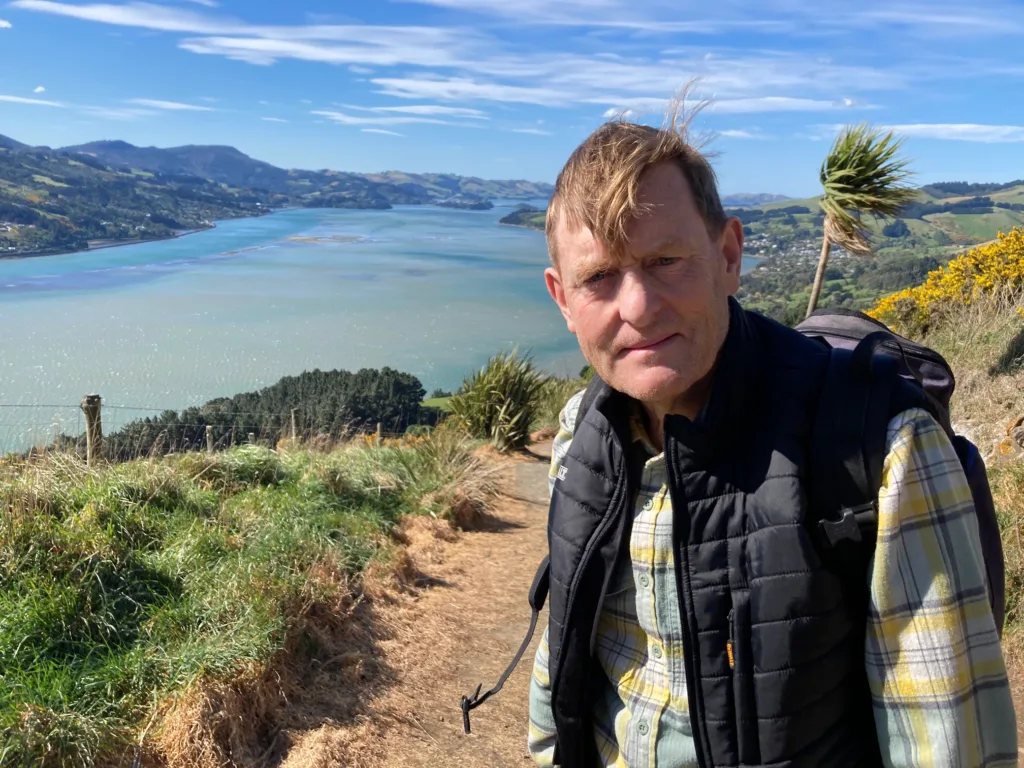
As an actor, Mark Strickson got to pretend to have adventures—but eventually, that wasn’t enough. He wanted to experience the real thing.
Best known to Doctor Who fans as Turlough, Mark went on to study zoology in Australia and build a career in wildlife filmmaking, including making Steve Irwin’s first film. His earlier experiences—as a musician, actor, and member of a theatre company touring Britain by narrowboat—came along with him in unexpected ways.
In this conversation, Mark shares how knocking on an office door landed him his Doctor Who role, why talent and hard work don’t guarantee success, and how a camera off its tripod helped create a different kind of wildlife television.
We also talk about Turlough’s complicated loyalties, the importance of a good script, the satisfaction of making things with your hands, and finding purpose in work that encourages people to care.
In this episode:
• Growing up with music and theatre in Stratford-upon-Avon
• RADA, poverty, and the role of luck in an acting career
• Life aboard Mikron Theatre Company’s narrowboat
• Getting cast in Doctor Who and finding the person behind Turlough
• Storytelling, special effects, and monsters that couldn’t move
• Returning to study and becoming a zoologist
• Working with Steve Irwin and cameraman Jeff Goodman
• Real adventures, conservation, and making television with compassion
Chapters:
0:00 Welcome and introduction
1:30 A childhood of music and theatre
5:50 Why acting success isn’t just about talent
9:59 Touring Britain on a narrowboat
17:11 How Mark landed Doctor Who
22:37 Understanding Turlough
30:59 Why the story comes first
33:27 Kamelion, the Myrka, and ambitious television
37:18 From acting to zoology
42:45 Becoming a wildlife filmmaker
46:19 Steve Irwin’s first film
53:07 Wanting real adventures
55:08 Making television that encourages compassion
58:21 Life and work in New Zealand
Want more? Here are handy playlists with all my previous interviews with guests in theatre and Doctor Who.
Come play with us: the free Follow Your Curiosity Creativity Circle is an hour each month to stop overthinking, make something just because you want to, and enjoy some creative company.
Get your free Daily Credit Report and Bingo Card.
Follow Your Curiosity is created and hosted by creativity expert Nancy Norbeck, creator of the Restorative Creativity Framework™. Music by Joseph McDade.
Enjoyed the conversation? Share it with a friend, and leave a rating or review wherever you listen—or on Podchaser.
Show Links: Mark Strickson
Mark doesn’t have a current website or use social media
Subscribe!
You can subscribe to Follow Your Curiosity via the handy links at the top of the page for Apple Podcasts, Spotify, iHeart Radio, TuneIn, and YouTube. If you enjoyed the episode, don’t forget to tell your friends!

Transcript: Mark Strickson
Please note: This is an unedited transcript, provided as a courtesy, and reflects the actual conversation as closely as possible. Please forgive any typographical or grammatical errors.
Nancy Norbeck [00:00:06]:
Welcome to Follow Your Curiosity. You didn’t lose your creative spark. You were taught to leave it behind. I’m creativity expert Nancy Norbeck, and I’m here to help you get it back. Let’s go. Mark Strickland started his professional life as an actor with roles on Angels, Doctor Who, and Casualty before studying zoology in Australia. Soon after gaining his degree, he wrote a film called The 10 Deadliest Snakes in the World, all of which are found in Australia. He went on to discover Steve Irwin, the crocodile hunter, and has gone on to make hundreds of documentaries.
Nancy Norbeck [00:00:42]:
He has held senior positions in several companies, including being head of programs at Oxford Scientific Films in London, and his clients include National Geographic, Discovery, and major UK and European broadcasters. Mark talks with me about starting his career as a musician before switching to acting, touring The UK on a narrowboat with the Mikron Theatre Company, his Doctor Who character, Turlough, the importance of good story in filmmaking from dramas to documentaries, working with Steve Irwin, and more. Here’s my conversation with Mark Strickland. Mark, welcome to Follow Your Curiosity.
Mark Strickson [00:01:18]:
Nice to be here, Nancy. It’s it’s always a pleasure.
Nancy Norbeck [00:01:21]:
Well, I start everyone with the same question. Were you a creative kid, or did you discover your creative side later on?
Mark Strickson [00:01:30]:
I think I was a creative kid. My dad was a musician, and he was organist at our local, very important church in The UK. It’s the church that Shakespeare was buried in, Stratford Upon Avon, Holy Trinity Church. It’s a very big church. It has lots of events in it. And I was in the choir as a chorister from the age of six, And, I I loved it. So if that was being creative, I don’t know. I mean, it mentions it’s being it’s being creative and artistic, in a sense.
Mark Strickson [00:02:03]:
I just loved… I loved singing, and I had a really really nice treble voice. And, I loved the theater about it. You know? It was a very high church, incense being swung as you came down the island, candles, you know, in special services and flowers everywhere. And, it was… It was, it was, it was a little bit of theater. And, absolutely adored it. So from a very young age, I went to church a lot.
Nancy Norbeck [00:02:31]:
You you and I have a, something in common then because I’ve been singing in choirs since I was about four.
Mark Strickson [00:02:37]:
Yeah. Yeah. That that that that’s true.
Nancy Norbeck [00:02:39]:
Yeah.
Mark Strickson [00:02:40]:
My best friend, and he won’t mind me mentioning his name. His name is Giles. But we met before we were born. My mother and his mother sat next to each other in a choir singing when they were both pregnant.
Nancy Norbeck [00:02:53]:
That’s fantastic. Did he sing too?
Mark Strickson [00:02:57]:
Yes, he did. He just got a lovely voice. Yeah.
Nancy Norbeck [00:02:59]:
Oh, wow. Wow. So then how did you end up progressing from singing to acting?
Mark Strickson [00:03:08]:
Well, being brought up in Stratford Upon Avon, the Royal Shakespeare Theatre is in Stratford Upon Avon. So it wasn’t it wasn’t a strange thing to be an actor at all. The town was full of actors, and they would read the lessons at church and judge the school speaking prizes and things like that. It it was normal to see quite famous people walking down the street, nobody turned a blind eye. And so I was I was born and brought up in that. And my my father wrote music to the theater as well. But I was very much brought up as a musician. I was a French horn player.
Mark Strickson [00:03:46]:
And then my brother applied for the National Youth Theatre. My brother’s much more arty than I am. He’s he’s a poet, and he was, doctorate of poetry at Leeds University, taught there for many years. But, he he applied for the National Youth Theatre and then didn’t wanna turn up for the audition. So I said, well, can I have it? And so I turned up. And I got in. But I got in to write the music. I started writing musical scores, right, for the National Youth Theatre.
Mark Strickson [00:04:18]:
It was really, really hard work. And I was 16, living on my own in London. I had no money. I was so poor. And, it was really tough. And it occurred to me that the actors had a much easier life than he is a musician. I mean, all they had to do was learn the lines, get on stage, and prance around a bit. So I decided I’d head towards acting.
Mark Strickson [00:04:40]:
And, they sort of couldn’t get out out of their head in the National Youth Theatre that I wasn’t… That I didn’t wanna be a musician, that I wanted to be an actor. But then I applied for I applied for drama school. And I have to say, I got into almost every leading drama school in The UK. And I hadn’t done much almighty drama or things like that. I’d recently… When I finished secondary school, I would… They they they did…
Mark Strickson [00:05:02]:
We didn’t even have… This is the town, right, where, Shakespeare was born. I went to the same school as Shakespeare. It was my local school. Right? We didn’t have a drama master. It was a boys’ grammar school. Right? We didn’t have anybody teaching drama. But the girls’ grammar school had a girls’, had a…
Mark Strickson [00:05:18]:
Which was in many ways a better school, had a had a a girl… A lady drama teacher. And she instituted, combined drama, school plays. Right? And so we did Pygmalion, and I played professor Higgins. And, I loved it. And I went to RADA. I got in to RADA, which I didn’t quite realize was such a privilege. I think they had 4,000 people apply for 20 places the year I got in.
Mark Strickson [00:05:50]:
That doesn’t mean anything. It means you won the lottery in a sense, because acting is a is a bit of a lottery to say the least. It’s one of the things I try… I’ve I’ve taught drama in the past, and one of the things I have to explain to people is if you aren’t successful, it doesn’t mean you’re not a good actor. It just means you weren’t in the right place at the right time. And there are many untalented actors who become very successful. But that’s… Don’t go into acting if you want to go into a profession that rewards hard work, is fair, all those…
Mark Strickson [00:06:24]:
It’s not. There’s a huge element of luck in acting, and I am on the right side of that. But, it’s easy to fall on the wrong side.
Nancy Norbeck [00:06:34]:
For sure. For sure.
Mark Strickson [00:06:37]:
I have some people I was at RADA with who were superb actors who didn’t go on to do anything really. Just one of those things.
Nancy Norbeck [00:06:46]:
It it it is. It’s amazing that it’s it’s a profession that that seems like it should be so talent driven, and yet No. I see. It’s it’s not. Yeah.
Mark Strickson [00:06:58]:
I mean, I’m not I’m not I’m not saying that if you’re, you know, if you’re a successful actor, you know, the Robin Williams’s of this world and things like that. I mean, obviously, I’ve got an enormous talent, but it’s not. It… Because you’ve got enormous talent, it doesn’t necessarily mean you’re going to be successful. You might just never be in the right place at the right time. There are no rules. You can work hard. You can write letters, emails.
Mark Strickson [00:07:19]:
You can publicize yourself. You can do all this and get nowhere. And if that’s gonna break your heart, don’t go into acting, I would say.
Nancy Norbeck [00:07:26]:
That sounds like good advice, even if it is extremely sobering advice, I’m sure, to many, many people.
Mark Strickson [00:07:34]:
Yeah. Yeah. Yeah. I mean, I was very lucky. So… Yeah.
Nancy Norbeck [00:07:39]:
Yeah. Yeah. I have to say, your your whole childhood experience, what you’ve told us about your childhood experience really sounds rather idyllic. And I’m sure that not all of it was, but, you know, being being in that very work at… Yeah.
Mark Strickson [00:07:57]:
In order to pay to do to go and stay in London on my own at sixteen
Nancy Norbeck [00:08:03]:
seventy eight….
Mark Strickson [00:08:04]:
Part so much. No. No. But… Well, then after you said, what I had to do at home was I worked in a bicycle factory, past this bicycle factory. I worked in a French restaurant, washing up from six at night till 03:00 in the morning. I mean, you name it. I did it.
Mark Strickson [00:08:16]:
I I worked really hard. And I have to say, when I was a student at RADA, I was very poor. There was no there was no student halls or anything like that. I lived in a horrible bed sit room, a tiny bed sit room in which the floor was rotten. The bathroom in the shared house had no roof in a place called Muswell Hill in London. And and I was absolutely thoroughly depressed and miserable for most of my student years. I got out from RADA. I got a job with the theater company.
Mark Strickson [00:08:44]:
Out of my first wage packet, I went and had fish and chips at 04:00 in the afternoon because I could afford fish and chips. It was amazing without thinking about it. And then, yeah, I was I was lucky as an actor.
Nancy Norbeck [00:09:00]:
Well, now you’ve kind of taken taken my mental image from Shakespeare and music to Wythnell and I.
Mark Strickson [00:09:08]:
Yeah. We’re very much with Nel and I,
Nancy Norbeck [00:09:09]:
I’ve got
Mark Strickson [00:09:10]:
to tell you. I’m not not as luxurious as with Nel and I. I’m not as funny.
Nancy Norbeck [00:09:17]:
Yeah. Yeah. I don’t I don’t know how many people who listen to this in The US will even have seen With Nel and I, but it is it is a classic for a reason, though it’s not an example of of a life you want to be living for very long, for sure.
Mark Strickson [00:09:32]:
No. You don’t want to live in very long. It’s wonderful to get out of it.
Nancy Norbeck [00:09:35]:
Yeah. I bet. I bet.
Mark Strickson [00:09:39]:
Harvard is romantic until you’ve lived it.
Nancy Norbeck [00:09:42]:
Yes. Yes. Yes. So when you did get that that first fish and chips,
Mark Strickson [00:09:52]:
which
Nancy Norbeck [00:09:53]:
must have felt like manna from heaven. Mhmm. Where did you go from there?
Mark Strickson [00:09:59]:
Well, I worked for that company. That that company was extraordinary. It was a company called Mikron, and they toured on a narrowboat. Now that’ll only explain to American businesses, American viewers. We… The UK has an amazing canal system, of 3,600 miles of navigable canals. And Macron is The UK’s oldest fringe theater company. It still still exists.
Mark Strickson [00:10:23]:
And it tours on a narrowboat. It tours on land in a bands and things. But it actually does tour the waterway system on a narrowboat. You can go from way South Of London to North Of Liverpool. You can do the whole of The UK. And you start with small theaters and at pubs. We we did… We worked at a lot of big pubs, and did art shows.
Mark Strickson [00:10:39]:
And it was documentary theater, about the industrial revolution, basically. I absolutely loved it because I was, helping guide a working boat around UK canal system. And, I was out in the country most of the time, and, I I I loved it. We lived in a little village outside Stratford, Avon, so I was very much born and brought home as a country boy. And, I… It was what I needed after two years, three years of poverty in London. I needed a break, and it was fantastic. And a lot of well known actors have have have have have been with Mikron.
Mark Strickson [00:11:16]:
One of the best well known is a guy called Mark Williams, whose father put out on television and things. But, lots of well known actors have done their time with Mikron. Mikron means Greek in small. It means… It’s small in Greek. Sorry. Nikon means small in Greek. But, strangely enough, the, the company was formed by two guys called Mick and Ron.
Mark Strickson [00:11:39]:
So there may be a less prosaic, solution to why it’s called Mikron. And Ron, he won’t mind me saying this, was an actor. Quite a well known actor, but his acting name was Danny Schiller. And, he left drama school, and, he had a limp. And his real name was Ron Leg. And he thought, I can’t go out into the world as an actor with a slight limp being called Ron Leg. I’ll change my name. Oh, now I know.
Mark Strickson [00:12:07]:
Jews do well in show business. I’ll change my name to Daniel Schiller. And he did. And hardly anybody knew that Daniel Schiller was really Ron Legg. There’s a film there, isn’t there?
Nancy Norbeck [00:12:21]:
There definitely is.
Mark Strickson [00:12:26]:
I’ve often thought about that. I’d love to make Danny’s life Danny’s life story.
Nancy Norbeck [00:12:31]:
Wow. Wow. But, yeah, I think that that would definitely be an awkward name to be saddled with trying to… Yeah. Clever solution. Clever solution.
Mark Strickson [00:12:43]:
He’s in loads of films. He’s in the he’s in he’s in the Clouseau films and things with Peter Sellers and things. If you look up Daniel Schiller, s c h I l l e r, on Wikipedia, you’ll find him. But he was Ron Legge, the Ron of Mikron, the company I started with. So that’s the first few years of my life. I’ve toured on that now and then doing theater and had a wonderful, wonderful time.
Nancy Norbeck [00:13:05]:
It’s such an interesting approach to send people out on a boat to tour around doing theater. I mean, I’ve…
Mark Strickson [00:13:11]:
It’s unique. It’s never unique.
Nancy Norbeck [00:13:13]:
Never heard of anything even remotely like that here.
Mark Strickson [00:13:16]:
No. Which is probably why it’s the UK’s longest running fringe theater company.
Nancy Norbeck [00:13:22]:
Yeah. And it’s still going now.
Mark Strickson [00:13:25]:
Yeah. Yeah.
Nancy Norbeck [00:13:26]:
That’s fabulous.
Mark Strickson [00:13:27]:
Very successful. It’s been going over forty years. Must’ve been going over fifty years now. Yeah.
Nancy Norbeck [00:13:35]:
That’s so cool. Just like… I I mean, so so you were all part of of running the boat as well as Yeah.
Mark Strickson [00:13:45]:
No. Absolutely. Yeah. Do it. Yeah. Yes. Yeah. Yeah.
Mark Strickson [00:13:47]:
I mean, it was a 30 ton boat, you know, to be guided through the canal system. And so you you were half boatman, half actor. Yeah. Yeah. And then every four days, we take it in turns to cook every five days. You had a… You had your cooking rotor. So to go off the boat on the bike, get the cooking things, cook while the boat was on the move, get get to the venue, set up the sets, set up the lighting, all that sort of thing.
Mark Strickson [00:14:13]:
And, of course, I wrote the music. I couldn’t get away from it, could I? You know, never mind. There you go.
Nancy Norbeck [00:14:23]:
Well, they imagine that, you know, if so many people in the theater world in The UK have done that, that also gives you, something in common when when you come across each other as well.
Mark Strickson [00:14:35]:
It does. We, about, six months after I left Midkron, they made an album, so we we made it at Abbey Road. So, you know, that was nice to to make an album at Abbey Road. Yeah. So another experience, another tick in the box.
Nancy Norbeck [00:14:53]:
Wow. Wow.
Mark Strickson [00:14:57]:
The album was deeply unsuccessful. I mean, only people who’d seen the service would buy it. I mean, don’t don’t go out and rush rush rush and try and find it. There’s probably a garage in the North Of England with about 4,000 copies still that, I mean, you know.
Nancy Norbeck [00:15:10]:
This is probably with a bunch of lost Doctor Who episodes in the same box.
Mark Strickson [00:15:15]:
There is no such thing as lost Doctor Who episodes. There we are. I’ll tell you a Doctor Who story. Alright? Because for the American, viewers who don’t know, I was in Doctor Who, which is why Nancy’s, one of the reasons why Nancy’s interviewing me. But, there’s always been, an urban myth that there are lost Doctor Who episodes of the Patrick Troughton years, and they would turn up somewhere. Well, television programs used to get delivered to television broadcasters in hard copy on on tapes to be shown. Right? And I thought… And I was right.
Mark Strickson [00:15:50]:
If they were gonna turn up anywhere, these these… Some more episodes of Doctor Who, they would turn up in Africa. Because there are lots of small countries in Africa who have small television stations, but it historically bought a lot of stuff from the BBC. And, I went into Sierra Leone with my TV producer, Hetar, making a film about chimps just after, the terrible civil war that happened there. And, they’d pretty much destroyed the the the television station in in Freetown, which is the capital of Sierra Leone. Sierra Leone’s on the East… Eastern Side Of Africa, and had a terrible civil war. And, I got in touch with the television station, and I searched high and low for those Doctor Who episodes, and I couldn’t find them.
Mark Strickson [00:16:35]:
But they were found in Africa. You’ll have to Yeah. Put that up. But I know that they were later, that they did find some lost episodes in in a small African country, which is where they were gonna turn up. Yeah.
Nancy Norbeck [00:16:46]:
Yeah. In the most unlikely places is where they tend to find them.
Mark Strickson [00:16:50]:
Well, the likely place. Africa, they never throw anything away. We know it was shown there. So it was actually the most likely place that Yeah. They would,
Nancy Norbeck [00:17:02]:
It’s wild. Wild. So… Mhmm. Well, let’s let’s kinda get you to Doctor Who because you go from the boat.
Mark Strickson [00:17:11]:
That was quite simple. I’ve I’ve tried… I don’t know why I’d… Maybe. I decided I’d go back to London, and I sort of do something else. Only two years on the boat was fine. It was wonderful and enjoyable. And then I went went back to London.
Mark Strickson [00:17:27]:
I’d been writing to a man from Lambeth Council. Now you can get a state house, right, if you apply to the council, if you’re very, very persistent. I had sent him a postcard for two years every week on my tours on the boat. I had nowhere to live. Right? And he got me a council flat in in a… On a terribly poor estate in London. And one of the responsibilities was that I formed a a community group… Helped form a community group, and we tried to bring the estate back to life.
Mark Strickson [00:17:56]:
This estate was opposite the Old Vic in London, within walking distance of the South Bank. You could hear, you know, Big Bend just up the road. This was a fantastic place to live. No travel costs. I had to walk and cycle everywhere. It was brilliant, but it was pretty rough. But I lived there I lived there for several years. So then I decided to better get an agent.
Mark Strickson [00:18:16]:
So I wrote to an agent. I have a lovely lady called Jan Evans, who’s still my agent. And, and and and she started getting me TV, auditions. And I started getting parts. I got part in a series called Strangers, Grenada. I got… I got a regular part in the soap opera Angels, which was the preceded two Eastenders, written by the same people and produced by the same people. Angels was a a nursing series set in Birmingham.
Mark Strickson [00:18:48]:
I come from Birmingham, which is why I can do a Birmingham accent. That’s a Birmingham accent, not a Birmingham accent. And I played Terry in Ambient and Striper. I ate a lot of cheese on toast, and I had a girlfriend called Alison. And so I did that. And, so that was that was that was that. And then I was offered the lead in Angels, the lead in a soap opera. And it was time…
Mark Strickson [00:19:13]:
Prime time viewing. Right? The most popular soap opera in The UK along the Coronation Street. Right? Hugely popular. And, the main actor became ill, and, they wrote me in as the main character, the main ambulance man. And, wasn’t that I didn’t want the regular money. I sure did. But I did want to know if I was up for anything else, so I rang Jan and said, am I up for anything else? And she said, yeah. Yeah.
Mark Strickson [00:19:40]:
Well, you’re up for a pilot in Doctor Who. And Doctor Who was a pretty big program back in in… I mean, it was getting 14,000,000 viewers on BBC one. You know? As if there were only three television channels at the time, you had to watch something. But it was it was an iconic program. And so so she said, but I I don’t… She’s… They’re not interviewing Mark, so I don’t know what you would do.
Mark Strickson [00:20:02]:
Well, I had a BBC card. So I went along. I found where the doctor who the office was. I knocked on the door, and a lady called Jane George answered the door, who was John Nathan Turner, who was the producer’s secretary. And I said, you don’t know who I am. My name is Mark Strickson. I’m currently in Angels, which was the soap opera, but I know I’m up for a part in Doctor Who. But you’re not auditioning for it yet, But can I see the producer? Can I see John? And she said, well, come in.
Mark Strickson [00:20:29]:
And he went in and saw John, and John said… And John sort of must have said to Jane, oh, I can find some time. And I went in and saw John, had a chat. And, he then got Eric Saward, the script editor, in, and I read for for them. And John said, Mark, could you just could you just give Eric and I a minute? And, I walked out. Jane got me a coffee or something. And then I went back in again. He said, Mark, he said, we’d like to offer you the part.
Mark Strickson [00:20:53]:
Now you are not allowed to tell anybody except your agent. As he said, we as the BBC have to be seen to be free and fair. We will still be auditioning for this part, but we think you’re absolutely right for it. He’s not allowed to tell anyone. You can tell your agent. That’s fine. But that’s it. Not even allowed to tell your wife, your girlfriend.
Mark Strickson [00:21:12]:
Nobody. So I said, fine. Fine. It’s a fine job. You know? I can keep you secret. So I walked out with the job. And on that same day, I got two other jobs. I got a part in Juliet Bravo, which was a police series, and and and I got the other part the other…
Mark Strickson [00:21:30]:
The part I got on, on Strangers. I think it was Strangers. But I do… I definitely got three three TV parts that day. And and my agent said, Mark, treasure this. This will net… I was ringing for a public call box. It’s a public call boxes you book coins in in those days.
Mark Strickson [00:21:44]:
Right? And, and she said, you will never have a day like this in your life again. Treasure it. And she was right. You do not get offered three jobs in a day. But there we are.
Nancy Norbeck [00:21:57]:
Oh, that’s amazing.
Mark Strickson [00:21:58]:
I went and knocked on the door. That’s how I got the parking lot to. They knocked on the door.
Nancy Norbeck [00:22:02]:
Yeah. Yeah. It’s amazing how often something that simple actually gets you somewhere.
Mark Strickson [00:22:08]:
Yeah. I mean, it it… If I hadn’t knocked on that door, I would never have been auditioned for the part and never got it. And…
Nancy Norbeck [00:22:14]:
Right.
Mark Strickson [00:22:15]:
Yeah. I’ve got another part. I must say Doctor Who’s life changing. It wasn’t in those days. It was just another… It was a job. It was a nice job, but it was a job as an actor. I changed tables at the BBC canteen.
Nancy Norbeck [00:22:26]:
Right.
Mark Strickson [00:22:27]:
Right. Simple as that. Right? So it wasn’t it wasn’t, you know, it wasn’t life changing in any way. But there you go.
Nancy Norbeck [00:22:37]:
Did they tell you when you auditioned that you were going to be the first companion who tried to kill the doctor?
Mark Strickson [00:22:45]:
No. But I’d I’d I’d… Because the the the the scene that I read for John and Eric, it was obvious that this character was up to no good. Okay. Right? I didn’t see a whole episode. You you you get sent the scripts in the in in the post. Right? And then you open them up and have a look at them. Right? So I had I had seen the whole script.
Mark Strickson [00:23:07]:
I actually had a holiday two weeks before I went to… Before I started to talk to you. I’d never had a holiday in years. Five years, I hadn’t had a holiday of any sort. I worked every break I had. And, I can’t tell a lie. I’ve been to Ireland in a van for five days with some friends from Ireland, if you call that holiday. Maybe that’s why I enjoyed Mikron so much on the narrowboat because it was almost like being a holiday except for, like, you had to work every night.
Mark Strickson [00:23:36]:
That was alright. But but… No. Well, my my my, wife to be and I, went went on a safing holiday to Brittany in France. It rained all the time. But we had a wonderful, wonderful time, and I came back and did my my first episode of Doctor Who having read the script. And I loved it. I mean, I thought I thought, look look, this this character is coming in really strong.
Mark Strickson [00:24:00]:
This is great. You know?
Nancy Norbeck [00:24:02]:
Yeah. I mean I mean, he is such an unusual character. And actually, I was I was just thinking this morning how, you know, it… It’s an unusual sequence. You know, John Nathan Turner gets a lot of guff from fans for all sorts of things as every Doctor Who producer does. But Yeah. You know, in a row, he had two male companions, which is unusual enough just to have one, and he killed the first one. And then the second one is out to kill the doctor for the first three stories that he’s in and kind of left for, you know, a while afterwards, like, okay, is, is Turlough a good guy now, or is he not a good guy now? And, you know, I’m I’m not convinced that Turlough was ever entirely a bad guy.
Nancy Norbeck [00:25:00]:
I think that Turlough was a character who was in a crappy situation and trying to survive. Yeah. He
Mark Strickson [00:25:07]:
was just in a situation where he had to survive. I mean, he was he was… He had to leave his own country. Right? And and and he’s doing everything he can to get back and sort things out there. So he’s never… He was never a bad guy, but he… But… Yeah.
Mark Strickson [00:25:23]:
I mean, the Black Guardian bought him off, basically.
Nancy Norbeck [00:25:25]:
Right.
Mark Strickson [00:25:27]:
Black Guardian said, I will help you if you help me. It’s it’s the pact with the devil, isn’t it?
Nancy Norbeck [00:25:33]:
Yeah. Though it was never, I don’t think, entirely clear exactly what that pact meant, you know, aside from…
Mark Strickson [00:25:40]:
You asked… You know. You don’t you don’t pass the script writers about that. You don’t ask Eric Sabin. Don’t ask me.
Nancy Norbeck [00:25:46]:
Like, the the full impact of what you’re getting into here, I don’t I don’t think was super clear for Turlough. I think it was just like, okay. Whatever you want, I’ll tell… If it’ll get me out of here. And and… Yeah. So I think I think he I think he is is maligned unnecessarily by a lot of people who view that as, oh, but he wanted to kill the doctor. Well, yeah, under extenuating circumstances.
Mark Strickson [00:26:12]:
That’s, yeah. And that’s that’s, I think that’s one reason I got the part. I’ll tell you a story about… I did a play for Channel four, almost immediately after I left Doctor Who. And it was about two couples, an older couple, who had rediscovered their relationship. It was set on a narrow boat. Why do you think they cast me? Going on a narrowboating holiday. Well, maybe somebody could steer the boat.
Mark Strickson [00:26:35]:
But it was it was a… And the younger couple, their marriage was falling apart. And, in the first scene, it was… My first scene in in the play, I was coming down the ladder into the boat’s cabin. Right? So I was just… Cameras below me. I was coming down. And the director, John, said, he said, we did the scene.
Mark Strickson [00:26:53]:
He said, thank god, Mark. You look evil on camera. Those eyes of yours. You look totally evil. I said, well, there’s nothing much I could do about that, John. Do I look like on camera? But maybe that wasn’t it. You know, I have my very clear blue eyes. And it’s it’s it’s the whole association.
Mark Strickson [00:27:09]:
And I’m, you know, fairly blonde. But, you know, it’s it’s the whole association with the Aryan young man, the blonde haired blue eyed guy, you know, the the ceili cold, icy eyes. You know, maybe maybe that was why I got the part of Turlough, that even if you even if you didn’t know, you didn’t quite trust this guy and somebody behind him.
Nancy Norbeck [00:27:31]:
Well, the moments with Turlough, like, I’m I’m thinking of the the scenes in in Frontios, which I especially like because there is some Turlough backstory in Frontios where, you know, he’s he’s having all of those traumatic memories. Definitely. Definitely. Those those are those those looks that are all in the eyes, and it’s like, woah, there is there’s something going on here that even if you didn’t… Even if you turned it on in that scene and you knew nothing about that character, you would know. Boy, some… Something’s up with this guy. For sure.
Nancy Norbeck [00:28:05]:
Yeah. I mean, it’s…
Mark Strickson [00:28:06]:
So, yeah, maybe. The tone was, apart from anything else, very lonely. Mhmm. Which isn’t a thing that’s isn’t a thing that’s, examined with doctor who assistance. You know, you you you’re on the TARDIS. You’re… You don’t know anybody. You’ve got nobody to talk to.
Mark Strickson [00:28:25]:
And and the and the script editor sort of tried to… Well, Eric tried to sort of do something about that, about making my relationship with Tegan much closer, you know. And and it was obvious that we were friends. It was never explored in the script, which I felt was a shame. But Doctor Who, by its nature, has to be quite simple because you’ve got the doctor who… You’ve got the baddie of the week, and that’s the story.
Nancy Norbeck [00:28:52]:
Yeah. There’s a lot going on.
Mark Strickson [00:28:54]:
There’s a lot going on. So you haven’t got enough… It’s not a historical drama. It’s not downs and abbey. You’re not gonna get all the ins and outs, the emotional ups and downs. Yeah. Yeah. It’s a very different beast.
Nancy Norbeck [00:29:06]:
And yet, now that we’re talking about it, I would love to have a big Finnish story that actually gives Turlo and Tegan a chance to kind
Mark Strickson [00:29:16]:
of
Nancy Norbeck [00:29:16]:
do some of that backstory. That would be great.
Mark Strickson [00:29:18]:
That would be that would be really nice. Yeah.
Nancy Norbeck [00:29:21]:
Yeah. You can…
Mark Strickson [00:29:22]:
That’s why I always say that science fiction is possibly the easiest genre to be absolutely terrible in as an actor, because it is so simple. There are goodies and there are baddies, and there’s a fight going on. That essentially is the plot of every science fiction story to go wrong. Goodies and baddies, a fight going on.
Nancy Norbeck [00:29:41]:
Yeah.
Mark Strickson [00:29:42]:
And that’s it. And, and yet you have to believe you’re a real person, or you’ll you’ll look terrible. You mustn’t question the plot. You mustn’t try and find faults in it. Oh, this wouldn’t happen. That wouldn’t happen. That’s not gonna help you in science fiction. You have to find a reason for it to happen, and a reason as an actor to believe that what’s happening in that scene is real.
Mark Strickson [00:30:04]:
That’s actually quite difficult to keep… Just particularly quite difficult to sustain.
Nancy Norbeck [00:30:10]:
Yeah. And yet, given the budget for Doctor Who back in the seventies, eighties, if you all hadn’t believed it, we wouldn’t probably be having this conversation.
Mark Strickson [00:30:26]:
What my son doesn’t believe is how much I was paid. He says… My son who’s 17 says, Don, you should be rich. You were quite famous, you know, and he did lots of other work other than doctor. Why aren’t you rich? Did you just spend all your money? I said, no, Tom. We weren’t paid very much in those days. It was as simple as that.
Nancy Norbeck [00:30:47]:
Yeah. Yeah. Because there’s no budget at all. It’s amazing though what what did get produced on screen with next to no budget at all. Yeah.
Mark Strickson [00:30:59]:
I think that Peter Davison is one of the strongest he is in the in in the series. But I do think it’s down to script writing. It’s just good scripts. All of them. Some of them were very, very good.
Nancy Norbeck [00:31:12]:
Yeah. I’ve always thought that it was story that carried that whole series. And when they brought it back, I was afraid that it would be overshadowed by special effects and that the story would suffer. And I’ve been very, very happy that that’s not what happened.
Mark Strickson [00:31:26]:
I think it’s happened in a few years.
Nancy Norbeck [00:31:28]:
That’s not… Yeah. But at first,
Mark Strickson [00:31:30]:
that was On and off.
Nancy Norbeck [00:31:32]:
That was my big fear in 2005. It was like, it’s gonna just be special effects all over the place, and there’ll be no story, and it’ll be a disaster.
Mark Strickson [00:31:41]:
Well, I see. I I do find most most, superhero films and science fiction deeply tedious. I don’t know how anybody can watch them. I mean, you’re just watching special effects. I mean, obviously, Avatar was made in New Zealand. You know, I think the films are ghastly. But it’s just me. I just can’t.
Mark Strickson [00:32:06]:
I just… Yeah. I I just don’t get it. I think it’s very clever, incredibly clever. But I I don’t get it. But it doesn’t interest me as as drama at all.
Nancy Norbeck [00:32:20]:
Yeah. Well, and and you said something at Gallifrey one this year that I’m gonna try not to totally misremember, but you can correct me if I’m wrong. But I think that it was that someone had told you that there were three things that you needed to to make…
Mark Strickson [00:32:35]:
No. That’s Hitchcock. You need something work. Hitch Hitchcock said there are three things you need if you if you’re gonna make a film. I think I think it’s plot, plot, plot. But it could be translated. The first is story, the second is story, and the third is story.
Nancy Norbeck [00:32:46]:
That was it.
Mark Strickson [00:32:47]:
Yeah. That’s what you need. And I think Hitchcock might have said the first is plot, the second is plot. That’s what he was saying. Right? Right? He says, oh, the first is the script, the second is the script, the third is the script. There’s no way past the script. If you haven’t got a story, you haven’t got a story. Actors can make weak stories slightly better.
Mark Strickson [00:33:05]:
What they can’t do is actors and directors cannot make a bad script good. It would always be a bad script. It’s the one thing you’re stuck with, and a good script will always be a good script. And a good script makes actors fly. It makes directors fly. They can see their way through it, and it’s the… Yeah. That’s that’s that’s that’s what…
Mark Strickson [00:33:26]:
Hitchcock was right.
Nancy Norbeck [00:33:27]:
Yeah. I think I think for sure. And and I feel like the elephant in the room here is Warriors of the Deep, which I think, for people who are listening to this, who are not familiar with Doctor Who, it’s like the famous story that was let down by being a BBC budget in 1983. I think it’s a great story that just couldn’t be properly done because it was 1983.
Mark Strickson [00:33:55]:
But that’s the story of John Nathan Turner, the producer’s history on Doctor Who, really. He… He’s always trying to do things that couldn’t be done. He was… Which is a good thing to be overambitious, and sometimes you fall on your face and sometimes you meet with a success. I mean, the the obvious, example of that is the is the character chameleon that that John brought brought in as as a robot, an alien robot that that that had its own brain and could… And he was persuaded by these people that they would be able to provide a robot that would walk, talk, and interact. Well, the technology wasn’t there.
Mark Strickson [00:34:31]:
Whatever your budget, that wasn’t there. It didn’t matter if you had millions, and Tom didn’t… And John didn’t have millions. Right? And so we we we got a robot that worked on a tape with set daps for us to insert lines as we reacted with it. So we had to work with the length of the line that they’d left, the gap that was left. So sometimes you might have a long line, and you had to do it incredibly fast. Sometimes you only have one word and they’d left the same length of time. So you had to think and look as if you were doing something and then say the one word and wait for Kamelion.
Mark Strickson [00:35:05]:
Yes. We we we… You know, we’d go across the studio and they’d say, yeah, okay. Oh, okay. On to the next thing. The comedian’s not ready. And there’d literally be his legs sitting there, then got the rest of it together.
Nancy Norbeck [00:35:17]:
Wow. They
Mark Strickson [00:35:17]:
did fantastically well, the technicians, but it was it was beyond what people could do in those days. I mean, it’s beyond what people can do nowadays, to be honest with the robots. They do it with CGI now.
Nancy Norbeck [00:35:28]:
Right. Right. That reminds me of the stories that I’ve heard about the K-9 prop too, but worse. Well, canine was pretty simple. Right.
Mark Strickson [00:35:36]:
The community was a lot more a lot more complex than canine. Yeah. K-9 was a dog on wheels. It was hard.
Nancy Norbeck [00:35:43]:
Right. Right. But Kamelion was an amazing idea had it worked. Yeah. Amazing idea.
Mark Strickson [00:35:48]:
Yeah. Yeah. I mean, amazing. And and I’m pretty sure it was our… It was John’s idea. And, yeah. But the technology wasn’t there. So there we go.
Nancy Norbeck [00:36:00]:
Right. Right. And and the same with with Warriors of the Deep, especially the Murka, which I think was what a couple of guys in a giant sea monster suit.
Mark Strickson [00:36:12]:
Yeah. Yeah. It was… There there there were two guys who, they were well known because there was a a famous children’s program on television at the time called Rent a Ghost, made by the BBC. And it had a horse in it, and they were the horse on Rent a Ghost. They were the front and back of the horse. So they knew all about manipulating four legged creatures and doing things. And so they were in the rehearsal room in a in a just as a cough over them, basically.
Mark Strickson [00:36:37]:
So we knew where the Murka was gonna be and could, you know, could react to it and all those sorts of things. But then when we got to the studio, they lowered the Murka costume onto them, and it was still wet from paint, right, and just been finished. And they couldn’t move. It was too heavy for them to move in it. So major cocker, but we survived. That’s the thing. Don’t… You you you just have to find a way out of it,
Nancy Norbeck [00:37:01]:
you know? You you just… Just find a way out. Right. Right.
Mark Strickson [00:37:04]:
If the if the monster doesn’t chase you or is incapable of chasing you, you have to look twice as wide and run twice as fast.
Nancy Norbeck [00:37:11]:
Yes. Yes. For some reason, it has to be even more terrifying than it would be otherwise.
Mark Strickson [00:37:16]:
So even more terrifying. Yeah.
Nancy Norbeck [00:37:18]:
Yeah. Oh, my. So when you left Doctor Who, you pretty much decided to do something completely different.
Mark Strickson [00:37:28]:
No. I didn’t. I was an actor for four, five years. But I knew… But I did… But about three three or four years later, I did decide that I did want to do something else. Right? And so I kept acting. I was in casualty.
Mark Strickson [00:37:39]:
I think I did the first abortion on British television, right, which is a medical soap opera. Right? I, I left The UK ten… Five or six days, not a… Not much more than a week after I finished on Casualty. Wow. And I went. I was really, really worried about the world, really, really worried about the state of the world. Being a country boy, I’d always been very interested in animals.
Mark Strickson [00:38:06]:
So I wanted to do something for the environment and, decided, I’d become a zoologist. So I went to Australia. I immigrated to Australia and did an honors zoology degree. Got a first class honors. There you go.
Nancy Norbeck [00:38:20]:
It just seems like such a a dramatic shift, and yet, you you know, it’s a good point about growing up around the country in a…
Mark Strickson [00:38:27]:
No. No. In my brain, it wasn’t it wasn’t… In my brain, it wasn’t a huge shift. I’d also been doing up houses in The UK on and off. Right? Which I still do. I love it. I like using my hands.
Mark Strickson [00:38:40]:
Television, obviously, I work as TV producer most of the time. But when you work as a TV producer, you sit in an edit room and you send this program off into the ether. You never watch it with anyone. Right? Who knows where it shows? I’ve I’ve seen a lot of my television programs in hotel rooms where I’ve just turned on the television when one of my shows has been on. I mean, by the time you’ve finished editing a show, you don’t wanna watch it ever again in your life. But you send it off, and that’s it, and it’s gone. And, you work with an editor, and that’s it. I mean, you’re in a darkroom with one other person.
Mark Strickson [00:39:13]:
It’s not a social life at all. And… Yeah. When you build, you do something with your hands, and at the end of the day, you can see what you’ve done. It’s a completely different feeling. And I am a good builder. I don’t just do a bit of DIY. I’ve just got an extension on the house.
Mark Strickson [00:39:33]:
Right? You know what I mean? Mhmm. So… And and, you know, yeah. I mean… And it also… It’s it’s physical. And I like I like using my body, and I like being physically tired, sleeping well at night, and those sorts of things. I mean, sitting in a dark room for ten hours a day is not my day of heaven.
Mark Strickson [00:39:51]:
And that… That’s what I have to do for a lot of my life. I mean, it’s very concentrated work as well, editing and producing. At that level, when you’re working to set deadlines to deliver programs, it’s pretty hard on. You know, it’s full on. I enjoy it. It’s fine. But, my…
Mark Strickson [00:40:10]:
But I also enjoy building. So I do that as well. But to get back to Australia, so what did I do when I went to Australia? First thing I did was buy a house and start doing it up. So I knew I had… So I knew I was making some money. Right? And then I did the equivalent of… I don’t know what the equivalent is in America, but I did the equivalent of biology, maths, and chemistry a level because I’d done English, music, and history at a level. I mean, I was very academically bright.
Mark Strickson [00:40:39]:
Don’t mind saying that. But, so I should really have gone to university rather than go to London, but I decided I wanted to be an actor somewhere. Yeah. And, so I started doing up houses. And and I did my… Externally, I did my biology, maths, and chemistry, equivalent of a levels, and I went to university in Australia the next year. Did biology.
Nancy Norbeck [00:41:05]:
That’s so wild. So cool.
Mark Strickson [00:41:08]:
If there’s anything you want to know about the biochemistry of overwintering in moths, I am your man. That’s what I did my work on. Complex carbohydrates in moths. It wasn’t something fluffy, like watching. It wasn’t animal behavior. It was very… Very biochemistry. Yeah.
Mark Strickson [00:41:26]:
And I did that deliberately. I forced myself down a hard line. I wanted to come out as a scientist.
Nancy Norbeck [00:41:32]:
Why moths?
Mark Strickson [00:41:35]:
There was a professor in the university who had a a PhD project he found. I wanted me to take over the PhD project and the research on it, and I got paid for it.
Nancy Norbeck [00:41:44]:
Good answer.
Mark Strickson [00:41:46]:
So it was interesting work, and, it gave me an income as well. Very nice. Yeah. Nice. It was… I had a… I had an interesting time at university. I also taught drama at university.
Mark Strickson [00:41:57]:
I taught in the theater studies department for four years. That also helped pay the rent, as well as me doing up houses. I’ve always been very busy.
Nancy Norbeck [00:42:05]:
Definitely. I mean, that’s so many things going on at the same time.
Mark Strickson [00:42:10]:
Yeah.
Nancy Norbeck [00:42:11]:
Yeah. Kept kept you busy.
Mark Strickson [00:42:15]:
I had chickens. I had ducks. I was pretty self sufficient. I made all my own wine. I imported big wine fermenting jars from Italy, because I had plum trees in the garden, lots of plum trees in the garden. I made all my… I made a bottle of wine for every day of the year. I made 300…
Mark Strickson [00:42:30]:
My aim was to make… And I achieved it, 365 bottles a year and some to give away to friends.
Nancy Norbeck [00:42:36]:
You must have been very, very popular.
Mark Strickson [00:42:39]:
Oh, that was. It was nice wine.
Nancy Norbeck [00:42:45]:
So when did the filmmaking come into all of this on top of… On on top of the 50 other things you were doing?
Mark Strickson [00:42:52]:
Yeah. No. I realized that when I was doing my zoology degree, I realized that, you know, one of the ways you could, and much more so then than these days, was you could change the way people thought through television, through making television programs. And nobody was really doing it. That was what was so interesting. The BBC had the BBC Natural History Unit, but they made observational films about animal behavior. They did not make any conservation films. It was many years until they started making conservation films.
Mark Strickson [00:43:18]:
Right? It’s not… It was never their brief, the BBC Natural History Unit. I think they’re fantastic, BBC Natural History Unit, but their brief is… Was not conservation at all. Right? So there were a few films made, but very few, and that’s what I wanted to do. And so I I realized that if you wanted to make television, there was no point sitting in Australia. You needed to be in The UK. I mean, that was the center of the documentary business on on on that side, on in the nature side of things.
Mark Strickson [00:43:47]:
And and any any films that were being made that I was interested in were being made out of The UK. So I came back to The UK, and I sat in a flat in London, in West Hamptons, and I wrote three films, because that’s how you do it. Being a TV producer is about writing. Being a TV documentary producer is about writing. You have to come up with an idea. You have to write it. You have to prove that it can be made. You have to budget it, and you have to sell it.
Mark Strickson [00:44:12]:
It’s all those things. Right? Until you’ve sold it, unless you have a private income, there’s nothing you can do because you have no money to make it. Right? So I wrote five films, and there’s a Doctor Who story here. I sent them off to, independent film companies in Bristol, which is the center of the documentary… Nature documentary industry. And a chap called Andrew Buchanan was head of development of a company called Partridge Films, which was a very famous producer of wildlife films. And Andrew rang me up. And he said, this is probably a stupid question, he said, but you couldn’t possibly be the Mark Strickland who was on Doctor Who.
Mark Strickson [00:44:48]:
And I said, yeah. Yes. This… That is me. He said, well, we’ll we’ll come around to what… How you’re doing this now and later. But he said, I’m the Andrew Buchanan, who was a production manager on Doctor Who when you were in it. And he’d retrained and become head of development at a independent production company.
Mark Strickson [00:45:06]:
So two of us had retrained. Again, right place, right time, a bit like acting. And I went down and saw them, and they thought they could sell two of the films. One of the films was about kangaroos, which sold to National Geographic. The the film was about the 10 deadliest snakes in the world, which were all in Australia. And again, right place, right time. I came back to The UK. Hardly anybody in The UK knew anything about Australia, let alone.
Mark Strickson [00:45:29]:
There hadn’t been films made about it, let alone had contacts there like I did in the zoology biz… You know, all all through. So I I came with something unique to offer a film company. I knew Australia. Yeah. I had contacts. Right? I had an Australian passport. I could open Australian bank accounts.
Mark Strickson [00:45:48]:
That proved to be very important. Right? So the money could come through my bank accounts. I have a fantastic credit rating to this day, because they put whole television budgets through my personal bank accounts. It looked like I was fabulously wealthy. So anybody lend me money for this incredible credit rating. And and to cut a very long story short, one of the films was the 10 deadliest lakes of the world, all of which were in Australia. I rode to reptile parks, zoos all over Australia. I needed a good snake handler.
Mark Strickson [00:46:19]:
And Terry Irwin sent me a a video of Steve Irwin. And it was Steve Irwin’s first film. And it was, I think, the most watched natural history program ever been made for The UK market. To to this place in the world. So I became a name director overnight.
Nancy Norbeck [00:46:36]:
I’m sure. I mean, just because Steve Irwin was such… Steve Irwin was enthusiasm in human form. So so that alone…
Mark Strickson [00:46:48]:
Not just Steve Irwin. Right? No. It wasn’t that. It was a whole lot of things coming together. Steve was great. Right? He obviously had no idea about television. He thought you just wrangled a snake and that was it. He didn’t understand about shots of the beach, jeep arriving there, shots of the landscape.
Mark Strickson [00:47:01]:
Why are we here? Why does this snake live here? He wasn’t a zoologist. He was a performer. Right? Steve was a fantastic guy, but he he wasn’t… He couldn’t see where I was headed and why all this information needed to be in there, right, to make it interesting. Mhmm. You can’t just stop the jeep, jump out, leap on a snake. That’s not interesting. That’s not gonna work.
Mark Strickson [00:47:24]:
Right? And so that that that was a battle to to to teach Steve that. But I also had a very good cameraman, mate, on on that job, Jeff Goodman. All sorts of things came together. I think it was the first ever natural history program shot on video, digital beta cam. Now, before that, it was shot on film. You can’t run around with a film camera. You can’t run. It’s very heavy, but you can run around with a digital beta camera.
Mark Strickson [00:47:46]:
Right? And Jeff taught me an important lesson is that if you’re gonna film animals, you need to film at the level of the animals. Now snakes had previously been filmed off a tripod. We got the camera on the ground. We ran after Steve. Right? The camera had never come off the tripod before in an age documentary. We were making it like reality television, but reality television didn’t exist. So we were way before our time. So I got back with the first lot of rushes to The UK, and my executive producer, who was very good.
Mark Strickson [00:48:15]:
Right? Said, we’re up for a reshoot. This is incompetent. Have you never heard of a tripod? What are you doing running along with the camera? So it wasn’t just Steve. It was a whole lot of things coming together. Because of the success of that film, it changed the way that people filmed presenters. And now you don’t expect the camera to be on a tripod. You expect it to be handheld when you’re filming a presenter. And, yes, the technology’s got better, and we can settle shots in the editing room and all those sorts of things.
Mark Strickson [00:48:43]:
Right? But nobody had done it before. It was totally new. So that was basically… Because I was inexperienced, and I trusted my cameraman, Jeff, and he was right. It was exactly the way to film that film.
Nancy Norbeck [00:48:57]:
There’s there’s something to be said for that, you know, for not knowing any better and Yeah. Going with your gut and trying something new that maybe you didn’t even really realize how new it was because it seemed like the right thing to do.
Mark Strickson [00:49:13]:
Well, I did, but I’d seen the camera come off the tripod in drama, but it had never been done in documentaries. Yeah. It just never been… They they never risked it.
Nancy Norbeck [00:49:24]:
I mean, there are so many things that I have seen, and and I was watching a documentary a while back that was set in New Zealand in one of those, you know, well underground caverns. And me being me, I’m the kind of person when I watch something like that, I’m thinking, you know they didn’t take a whole film crew down there. So how did they film that? Like, I’m the kind of person who’s asking those questions while I’m watching things like that.
Mark Strickson [00:49:48]:
Well, what was this film?
Nancy Norbeck [00:49:49]:
I I don’t… I filmed a lot in TV. Well, and that that was why I I wanted to remember to ask
Mark Strickson [00:49:56]:
you a question. You do take a whole documentary film crew down.
Nancy Norbeck [00:49:59]:
Do you really?
Mark Strickson [00:50:00]:
Whole documentary film crew is a director who carries the tripod over. Right? A cameraman and a lighting guy and a sound guy. There’s four of you. Okay. There’s often only three of you. And between the cameraman and the sound guy and and the director, you do the lighting.
Nancy Norbeck [00:50:15]:
Okay. Because I kept thinking, how do you even get…
Mark Strickson [00:50:17]:
Not this huge crew. When we go for these big shoots abroad, there are two of you, the director and the talent.
Nancy Norbeck [00:50:22]:
Oh, okay.
Mark Strickson [00:50:22]:
I mean, I spent four months in in in Indonesia filming Komodo dragons. So two of us.
Nancy Norbeck [00:50:28]:
That makes more sense then.
Mark Strickson [00:50:31]:
You you don’t need any more people. And the more people you have around to film animals, the least… The less likely it is you’re gonna see an animal. You want to see as few people as possible. Yeah. Yeah.
Nancy Norbeck [00:50:43]:
Yeah. But I I just kept thinking… And, of course, I’m probably picturing something, you know, a film crew that I saw on some documentary for twenty years ago too. So I’m sure everything is smaller. But I just kept thinking, how on earth do you get all of this stuff down into this cavern? So… Yeah.
Mark Strickson [00:51:03]:
Yeah. Not since we’ve always used very small film crews. And often, in order to get the behavior, even the director doesn’t go there. Someone goes in there and sits alone. Because you need to create minimum disturbance, and disturbance is things like body smell. Animals can smell humans, and it can freak them. So one body smells less than two bodies.
Nancy Norbeck [00:51:24]:
Right. And no bodies are in the…
Mark Strickson [00:51:27]:
So all these things become… This is why I do think it’s very, very difficult to film natural history if you’re… If if if you haven’t got a background in zoology, a sort of fairly formal professional background in zoology, you need to know your shit. You need to know how that animal is functioning in in order to get the the result you want.
Nancy Norbeck [00:51:48]:
It makes perfect sense. And it makes perfect sense that that you’ve got exactly the right combination to do this. I… I’m just… I I find the whole thing so fascinating. It’s very cool.
Mark Strickson [00:52:02]:
Well, Steve, I mean, again, I mean, my drama background really helped me with Steve. Steve was very easy to to to direct and and and found being directed, I think very useful for him. But, you know, if you’re if you’re directing actors and you want them… It’s an emotional scene. You come to the actor and you say, okay. Now what you’re not quite giving me is this and this, and you’re not, you know, absolutely, you just push it a little bit there, and and you you you reduce your body language and and you you… You know? Whereas if you’re in a filming an action scene, you want people to do things, you can shout at them. Right? Come on, guys.
Mark Strickson [00:52:37]:
You know? Right? And ignore from you there. Right? And Steve very much responded to that way. That if I wanted him to be quiet and calm, then if I was quiet and calm, he was quiet and calm. And then if I wanted him to be excited, I’d say, Steve, do what you want. Just get on with it. Have fun, mate. Right? And he he took direction very well.
Nancy Norbeck [00:52:57]:
Because I could see where it would have been an interesting adventure to work with him and, you know, on all the other projects that you’ve done.
Mark Strickson [00:53:07]:
It it was certainly an interesting adventure, but it it was an adventure more than anything else. My mother’s father was in the Merchant Navy and traveled all over the world and was invalided out. He had a spear through his nose on on South Sea Ireland. Right? He was… I mean, he he died when I was young, and he was old. But he was he was on the big sailboats coming around the horn in front of the mast up the rigging, you know, preparing sails and things. I mean, this was a this was a… He ran away to sea when he was 14 I’m at a different time, obviously.
Mark Strickson [00:53:39]:
And, he… I always felt that… I’d sit in Sydney Harbour and sit on these old steps and think, my granddad could have sat here.’ He would be the last member of my family who would have sat on these steps. And I did want adventure in my life. And, that’s what I wasn’t having as an actor. You pretend to have adventures as an actor. Let’s face it. You don’t have adventures.
Mark Strickson [00:54:04]:
You pretend to. I wanted to do it for real. And the… At the time, the BBC rehearsal rooms, which is mostly where I work, were on a traffic island in West London. I wasn’t having any adventures. I mean, I enjoyed acting. I still enjoy acting to this day, but it it certainly wasn’t gonna take me across the world. I’ve I’ve lived in some of the remotest places you could find, places you could never get to as a tourist.
Mark Strickson [00:54:28]:
And I’ve seen incredible things. So, yeah, it’s been… It has been a life full of adventure. Now those sorts of adventures have stopped. Now you get too old for it. It gets too dangerous. You can’t get an insurance to to… I mean, I’m not that old.
Mark Strickson [00:54:46]:
But you you do have to be quite careful. And I’m 66. But, you don’t really want to go to live in incredibly remote places in… Under dangerous circumstances at my age. You just… You don’t you don’t bounce like you used to. It’s the only way I can put it.
Nancy Norbeck [00:55:08]:
Yeah. That’s a fair consideration, for sure. For sure. But… But you’re still making things.
Mark Strickson [00:55:16]:
Oh, yeah. I still make heat television. I’m a television factory. I make a pair of a rich house, poor house at the moment, which is very, very popular in The UK. It’s on Netflix in America. And a rich family swaps life with a poor family. And they live on their budget for a week. And the poor family lives on the rich family’s budget, and the rich family lives on the poor people’s budget.
Mark Strickson [00:55:39]:
It’s really about the rich family in some ways, because they do have to live on a very small amount of money. Now if I went into a commissioning editor’s office and said, I wanna sell you a prime time program. It’s all about poverty. It’s all about how difficult poverty is. You’re never gonna get anywhere. But this is poking around different people’s houses. It’s the… It’s it’s the complete change of life from having limitless money, you know, to having almost nothing to live on.
Mark Strickson [00:56:11]:
And a whole… And a family swap places. Right? It’s it’s compelling television, I have to say. And hopefully, by the end of it, I’ve made you cry. If I haven’t, I haven’t done my job. But it’s a way of showing people how what a struggle life is for lots of people in this world. And I think that’s worth doing.
Nancy Norbeck [00:56:31]:
I agree.
Mark Strickson [00:56:32]:
You know?
Nancy Norbeck [00:56:32]:
I agree.
Mark Strickson [00:56:33]:
Compassion in, you know, in helping inspire compassion. I think we just don’t think poor people are lazy and can’t be bothered. It’s got nothing to do with that. It’s got something to do with that sometimes, but usually nothing to do with that. It’s got to do with time and place and life circumstances and all those things.
Nancy Norbeck [00:56:50]:
And sometimes, as we’ve been saying in this conversation, just plain luck.
Mark Strickson [00:56:55]:
Yeah. Yeah. Or or lack of luck. Yeah. Being unlucky. Yeah. Just is not going right for you. Yeah.
Mark Strickson [00:57:03]:
Yeah. So it’s it’s often very… It’s often… I mean, there’s lots of humor in it always, but it usually finishes on quite a sentimental note. And there are moments of sadness and and reality in it. But we’re always… One of the things is we’re always very respectful for both families. We we never rubbish anyone.
Mark Strickson [00:57:25]:
It’s, yeah, that’s that’s our that’s our golden rule is show respect.
Nancy Norbeck [00:57:29]:
Well, and that… I think anything that we can do right now to create more compassion is desperately needed. Absolutely.
Mark Strickson [00:57:38]:
Yeah. Absolutely. Yeah. So that’s that’s… I I I get up in the morning and think I’m doing something worthwhile with my life. Still?
Nancy Norbeck [00:57:46]:
Yes. I would agree with that. I would agree. Well, I really appreciate you taking the time to share all of this with me. I think it’s a fascinating journey that you’ve had.
Mark Strickson [00:57:57]:
Well, I’m about to go off and paint skirting boards. So there you go. Now I’ve got I’ve got a house I’m trying to finish. I do… I mean, it’s a business for me. Right? I do have houses, and I’ve got I’ve got flooring going down tomorrow. And I need to do a fairly long day today, finishing work off before I get the following. I’m gonna have a day off on Monday because I’ll have worked all weekend.
Mark Strickson [00:58:16]:
So I do give myself the occasional day off. I might read a book or something.
Nancy Norbeck [00:58:20]:
There you go.
Mark Strickson [00:58:21]:
I have a nice coffee shop at the end of the road, so I take my book up there and a couple of coffees. You know? So… Yeah. New Zealand is… New Zealand New Zealand’s an interesting country. I mean, where I live where… I just I should tell you a little about where I live. I mean, how did I end up in New Zealand? I ended up here because I came out here to work on a program for Animal Planet and met my wife, and I stayed.
Mark Strickson [00:58:40]:
And I’ve been here twenty years. I live in the South Of New Zealand, and the climate is not good. It’s about… It’s a night living up a fairway up Scotland. So it’s never… I think we… Our headline on the paper this year was five warm days this summer. It’s cold a lot of the year.
Mark Strickson [00:58:59]:
And we’ve got seven days of rain at the moment. So you need to you need to be cozy. And it’s gray skies a lot of the time. When the sun comes out, it’s absolutely beautiful. It’s it’s blue skies. It’s gorgeous. And and New Zealand is a beautiful country, but it’s… I would say if you come to New Zealand, it’s a bit like Ireland.
Mark Strickson [00:59:16]:
Don’t come to New Zealand for the weather. Certainly, don’t come to the South Of New Zealand for the weather. You can come to the South Of New Zealand and see penguins and seals on the beach and albatross and things like that. But pack pack some warm and waterproof clothes for any time of the year.
Nancy Norbeck [00:59:33]:
I was I was lucky enough to come to New Zealand in 2017.
Mark Strickson [00:59:38]:
Wow.
Nancy Norbeck [00:59:38]:
And it’s one of the most gorgeous places I have ever been to, though most of the week that I spent in Queenstown was pretty gray.
Mark Strickson [00:59:46]:
Yeah. I’m afraid that… Yeah. I’d say Yeah. It’s it’s… It don’t come for the weather.
Nancy Norbeck [00:59:52]:
Yeah. I got one or two nice days, and I’m very glad that I got them. But Yeah. But it was gorgeous.
Mark Strickson [00:59:59]:
Yeah. I know. It’s a lovely… It’s… I mean, it must be nice. I’ve been here twenty years.
Nancy Norbeck [01:00:03]:
Yeah. Well, I would think it’s a great place to be, you know, making documentary films.
Mark Strickson [01:00:08]:
Well, you can make documentary films anywhere. It doesn’t matter if I’m sitting in an edit room in Soho or I’m sitting in an edit room in Dunedin in the South Of New Zealand. True. I just send a cut off, get notes back, send another cut off, get notes back, finish the program, lock it off, send it off into the ether. Doesn’t matter where I do that. What it does require, because people say, how do you work out of Dunedin? Because, they are… To say the least, there’s me. There are a few other people in the TV business.
Mark Strickson [01:00:33]:
But, the answer is you come… You don’t come and live in Dunedin or in the South Of New Zealand unless you’ve already got a well established career. So there’s a lady here who works with plum pictures in in The UK, and she edits programs then. She’s just sort of one hour on Taylor Swift. But she’d worked for them for twenty years before she came to Dunedin. A bit like me, I was a well known TV producer. So if you’re a trusted pair of hands, it’s fine. You can live anywhere in the world.
Mark Strickson [01:00:56]:
What you can’t do, for all those young people who wanna be TV producers, you can’t start off anywhere in the world. Yeah. But it is lovely. It’s lovely to be able to live somewhere nice, and be able to earn a living.
Nancy Norbeck [01:01:10]:
Yeah. Well, I hope you’ve managed to keep doing it for a a good long while to come because it’s fascinating stuff.
Mark Strickson [01:01:20]:
I don’t I don’t wanna do it that much longer. Another five years.
Nancy Norbeck [01:01:23]:
Well, for as long as you want to. Let’s put it that way.
Mark Strickson [01:01:25]:
Another five years, Nancy. Then I then I I might take it a bit easier. It’s pretty, I mean, it’s pretty hard work, so that’s the only thing. But it’s it’s hard work that I enjoy, which is which is fine. But it’s not a walk in the park, I can tell you.
Nancy Norbeck [01:01:37]:
Yeah. Well, if you have good good work that you love to do that means something to you, I think that’s really everything.
Mark Strickson [01:01:45]:
Yeah. It is. And there’s a purpose to it. That’s what I would just thought. There there has to be a reason for it. It’s not… I’m not interested in making Love Island or married married at first sight. I’m sorry.
Mark Strickson [01:01:58]:
I don’t care how much money I’d make. I’m not interested in doing it. It would it would kill me. It would kill my soul.
Nancy Norbeck [01:02:03]:
Right.
Mark Strickson [01:02:03]:
Right? But… So I do I do… Yeah. But I… I’ve always done work that I enjoyed. I’ve been lucky.
Nancy Norbeck [01:02:11]:
Yeah. May we all be so lucky.
Mark Strickson [01:02:17]:
Yes. And on that thought Yeah. Lovely to talk to you, Nancy.
Nancy Norbeck [01:02:21]:
You too. Thank you so much. That is our show for this week. I am so grateful to Mark Strickson and to you for listening. Mark’s links are in the show notes. I hope you’ll leave a review or comment for this episode. There is a link right in your podcast app, and it is super, super easy and really, really makes a difference. If you enjoyed our conversation, please do share it with a friend.
Nancy Norbeck [01:02:43]:
Thank you so much. If you’re tired of being productive and just want to feel alive again, come join us in the follow your curiosity creativity circle. It’s a free hour each month to stop overthinking, make something just because you want to, and reconnect with the part of you that remembers how good it feels to play. You can find it at the link in your podcast app. See you there, and see you next week. Follow Your Curiosity is produced by me, Nancy Norbeck, with music by Joseph McDade. If you like Follow Your Curiosity, please subscribe, rate, and review on Apple Podcasts or wherever you get your podcasts. And don’t forget to tell your friends.
Nancy Norbeck [01:03:26]:
It really helps me reach new listeners. Thanks so much, and see you next week.